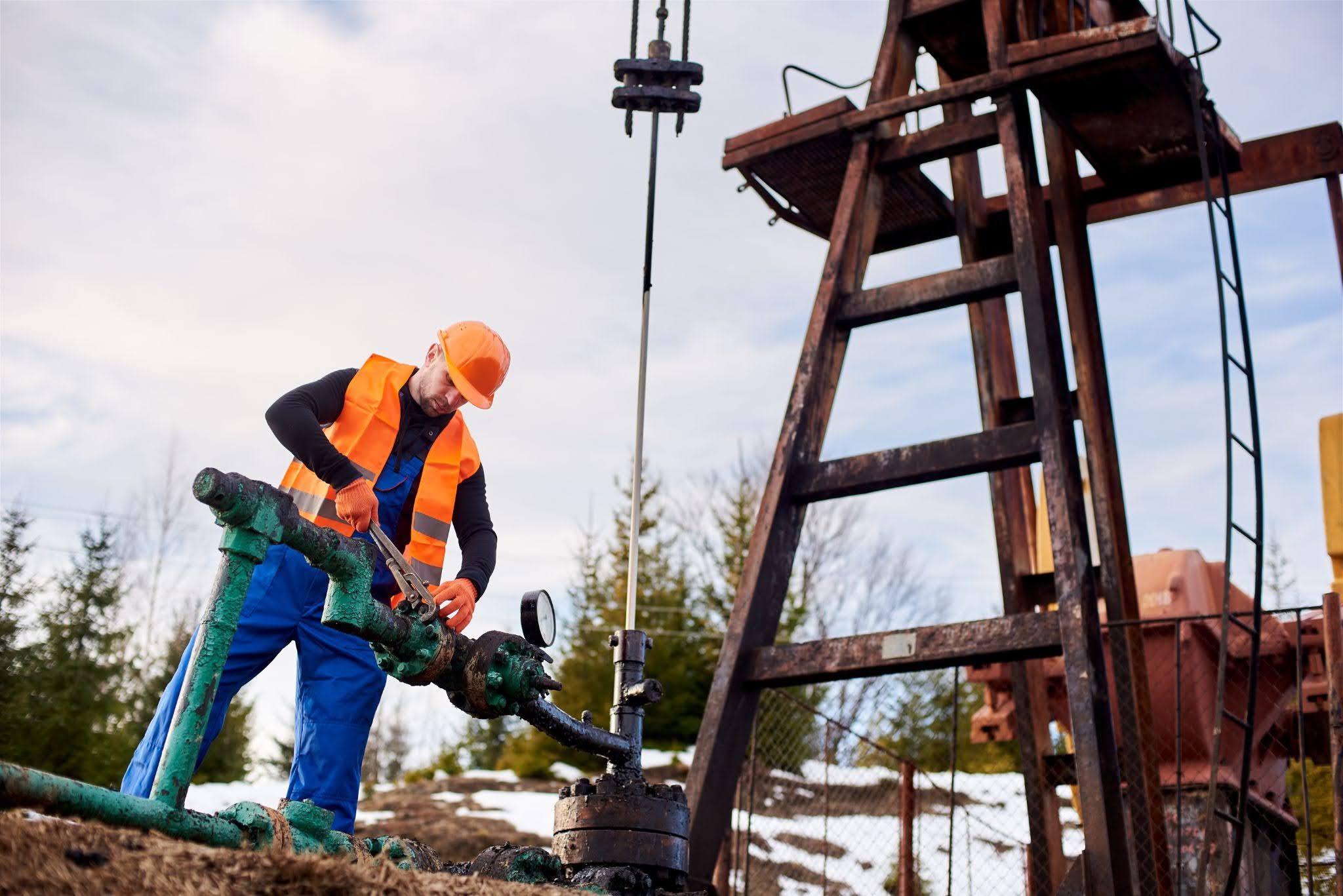
If an oil or gas company has already drilled a well on or near your mineral acreage but has not started producing, you may be wondering whether to sell your mineral rights now or wait for future royalty payments.
The well could be what the oil and gas industry calls a DUC well, short for a drilled but uncompleted well.
For mineral rights owners, a DUC well can represent potential future income. However, a drilled well does not guarantee production, royalty payments, or a higher mineral rights valuation.
That uncertainty creates an important financial question: Should you sell mineral rights before production begins, or hold onto your ownership and wait for potential royalties?
The answer depends on several factors, including the well’s completion status, operator activity, your ownership interest, commodity prices, and your financial goals.
This guide explains what a DUC well is, why operators delay completion, how DUC wells can affect mineral rights value, and what to consider before making a selling decision.
What Is a DUC Well in Oil and Gas?
A DUC well (drilled but uncompleted well) is an oil or natural gas well that has been drilled but has not yet undergone all the completion work necessary to prepare it for production.
According to the U.S. Energy Information Administration (EIA), operators sometimes leave wells uncompleted for months or longer while coordinating completion operations or responding to market conditions.
Drilling a well and completing a well are two different stages of oil and gas development.
Drilling creates the wellbore that reaches the targeted underground formation. Completion involves additional operations needed to make the well capable of producing oil or natural gas.
Depending on the well, completion work can include perforating, hydraulic fracturing, installing production equipment, and preparing the well for commercial operations.
A DUC well has therefore progressed beyond the initial drilling stage, but it is not yet a producing well.
For mineral owners, this distinction matters because an unfinished well may indicate development potential without generating royalties from that particular well.
How Does a DUC Well Become a Producing Well?
Understanding the stages of oil and gas development can help explain why mineral rights value may change as a project progresses.
|
Development stage |
What happens |
What it means for mineral owners |
|
Drilling permitted |
The operator receives authorization to drill |
Development is possible, but not guaranteed |
|
Well drilled |
The wellbore is constructed |
The operator has invested in drilling |
|
DUC well |
Drilling is finished, but completion remains outstanding |
Potential future production remains uncertain |
|
Well completed |
Required completion operations are performed |
The well may be ready to begin production |
|
Production begins |
Oil or gas is produced and marketed |
Eligible royalty owners may begin accruing revenue |
|
Royalty distribution |
Production proceeds are allocated and paid |
Owners may receive payments under applicable agreements |
Even after a well is completed, commercial production and royalty payments are not guaranteed.
Actual payment also depends on ownership, unit participation, lease terms, product sales, and the operator’s accounting and payment procedures.
Why Do Oil and Gas Companies Leave Wells Uncompleted?
If drilling has already been completed, why would an operator delay bringing a well into production?
There are several practical and economic reasons.
1. Oil and Gas Price Uncertainty
Commodity prices influence when operators choose to invest in well completions.
If prices are unfavorable, a company may postpone completion while waiting for better economic conditions.
This does not necessarily mean the well has poor production potential. However, there is no guarantee that improved prices will lead to immediate completion.
2. Completion Crew and Equipment Availability
Modern horizontal wells often require specialized equipment and hydraulic fracturing crews.
Operators may schedule several wells for completion together to improve operational efficiency.
A well can remain unfinished while equipment or crews are assigned to other projects.
3. Pipeline and Infrastructure Limitations
A completed well still needs appropriate facilities to move its production to market.
Limited pipeline capacity, gathering infrastructure, or other operational constraints may delay completion or startup.
These challenges can be particularly important in areas experiencing significant drilling activity.
4. Operator Development Strategy
Oil and gas companies frequently manage multiple wells and drilling locations across a large operating area.
They may drill wells first and complete them later to coordinate budgets, equipment, and development schedules.
The EIA explains that maintaining an inventory of DUC wells gives operators flexibility in managing drilling and completion activities.
5. Changes in Financial Priorities
Operators may reduce spending, redirect capital to other projects, or modify development plans.
As a result, some DUC wells remain uncompleted longer than initially expected.
Important: A DUC well is not necessarily an abandoned or unsuccessful well. Nevertheless, its completion date and future production remain uncertain.
How Does a DUC Well Affect Mineral Rights Value?
A DUC well can influence mineral rights value because it provides additional information about development activity.
However, the presence of a drilled but uncompleted well does not establish a specific market value or guarantee an increase in the owner’s royalty income.
Several factors determine how much a DUC well may matter to a prospective mineral rights buyer.
Drilling Activity Shows Operator Investment
A drilled well indicates that an operator has already committed resources to developing the property.
That may provide more evidence of potential future production than an undeveloped tract with no drilling activity.
However, buyers must still evaluate whether the well is likely to be completed and whether the mineral interest being purchased participates in its production.
Completion Timing Affects Financial Expectations
A well expected to enter production soon may be evaluated differently from one that has been uncompleted for an extended period.
An extended delay can create uncertainty about future revenue and its timing.
Buyers may account for that uncertainty when estimating the value of mineral rights.
The Operator's Development Plans Matter
An established operator with active completion operations may present a different development outlook from an operator that has postponed projects or reduced capital spending.
Still, no operator’s plans should be treated as a guaranteed completion schedule.
Mineral Ownership Determines Royalty Participation
One of the most important considerations is whether you actually own a royalty-bearing interest in the well.
A DUC well located near your mineral property does not automatically mean you will receive royalties from it.
Your participation can depend on the well’s producing unit, applicable pooling arrangements, deed language, lease terms, and ownership percentage.
For example, a mineral owner may have property near a horizontal well but hold no interest in the unit from which that well produces.
A proper ownership and unit review is essential before assigning value to the potential royalties.
Should You Sell Mineral Rights Before a DUC Well Starts Producing?
Selling mineral rights before a DUC well begins producing may be worthwhile if you prefer a known lump-sum payment over uncertain future royalty income.
However, retaining your mineral rights may be more appropriate if you can tolerate production delays and want to participate in potential future revenue.
Neither option is automatically better.
The decision depends on the purchase offer, the property’s development prospects, and your personal financial circumstances.
Reasons to Consider Selling Before Production
1. Receive a Lump-Sum Payment
Selling mineral rights can convert a potentially uncertain future income stream into an agreed payment at closing.
That money may support financial goals such as debt repayment, retirement planning, major expenses, or other investments.
2. Reduce Exposure to Production Uncertainty
A DUC well may be completed and become productive, but it can also remain unfinished or produce less than expected.
Selling transfers the future economic upside and downside of the interest sold to the buyer, subject to the transaction terms.
3. Avoid Waiting for an Uncertain Completion Date
Operators may postpone completion for operational or economic reasons.
If immediate liquidity matters more to you than potential future royalties, a sale may be worth considering.
4. Simplify Mineral Asset Ownership
Managing mineral interests may involve tracking operators, production records, royalty statements, and ownership documents.
Some owners prefer selling their interest rather than continuing to monitor these matters.
Reasons to Consider Waiting Until Production Begins
1. Observe Actual Well Performance
Once the DUC well begins producing, early production records can provide additional information about the well’s performance.
This may make it easier to evaluate possible future royalty income.
However, initial production does not reliably establish the well’s lifetime output.
2. Participate in Potential Royalty Income
If the well becomes commercially productive and your interest qualifies for royalty participation, retaining ownership may provide payments from production.
Those payments will depend on the applicable royalty interest, production volumes, prices, and other contractual factors.
3. Obtain More Information Before Selling
After production begins, buyers may have additional data for evaluating the property.
The added information might support a higher valuation, but it could also reveal weaker-than-expected performance.
4. Retain Long-Term Ownership
Keeping your mineral rights may preserve your ability to benefit from eligible future development, subject to existing leases and other ownership restrictions.
Selling Mineral Rights Before vs. After DUC Well Production
Here is a comparison of the main considerations.
|
Factor |
Selling before production |
Waiting until production |
|
Payment timing |
Potential lump sum after closing |
Potential royalties after qualifying production and payment processing |
|
Production uncertainty |
Buyer generally assumes future production risk for the purchased interest |
Owner retains exposure to future performance |
|
Available well data |
Development and completion information may be limited |
Actual production data may become available |
|
Future royalty upside |
Transferred with the interest sold |
Retained by the owner |
|
Commodity price exposure |
Reduced for the interest sold |
Continues to affect future royalty proceeds |
|
Ownership flexibility |
Ends for the interest sold, subject to deed terms |
Retained, subject to applicable agreements |
The decision should be based on the actual purchase offer rather than an assumption that prices always rise once a DUC well enters production.
Will Mineral Rights Be Worth More After a DUC Well Is Completed?
Not necessarily.
Mineral rights may become more valuable when successful production provides evidence of attractive future royalty income.
But a completed well can also underperform, experience technical problems, or generate less revenue than anticipated.
A production increase does not automatically translate into a proportional increase in mineral rights value.
For example, consider two hypothetical outcomes.
Scenario A: The DUC Well Becomes a Strong Producer
An operator completes a well, and the well begins producing at commercially attractive rates.
If the mineral owner participates in the well, the resulting royalty potential may support a more favorable valuation.
Scenario B: The Well Produces Less Than Expected
The operator completes the same type of well, but production is significantly below expectations.
The resulting mineral rights valuation could be lower than an earlier offer based on optimistic development assumptions.
These scenarios explain why waiting for production involves both potential rewards and risks.
Production history can reduce some uncertainty, but it cannot eliminate future price changes, declining production, operating disruptions, or additional development uncertainty.
How to Estimate Potential Royalties From a DUC Well
Before deciding whether to sell mineral rights before production, it helps to understand how ownership relates to possible royalty income.
A simplified estimate of royalty participation in a conventional pooled unit may use:
Net Revenue Interest = (Net Mineral Acres ÷ Unit Acres) × Lease Royalty Rate
For example, assume the following hypothetical information:
- Net mineral acres owned: 10
- Producing unit size: 640 acres
- Lease royalty rate: 20%
- Assumed full participation and no special allocation adjustments
The estimated net revenue interest would be:
(10 ÷ 640) × 0.20 = 0.003125
That represents approximately 0.3125% of the applicable production revenue, before any permitted deductions, taxes, or other adjustments.
If the hypothetical well generated $500,000 in applicable gross production revenue during a month, the simplified royalty calculation would be:
$500,000 × 0.003125 = $1,562.50
This is an illustration, not a royalty forecast.
Actual ownership calculations can be more complicated, particularly with horizontal wells, overlapping units, royalty reservations, or special allocation methods.
A DUC well has no established production revenue from that well to insert into this calculation. Any preproduction estimate depends on assumptions that could prove incorrect.
How Long Can a DUC Well Remain Uncompleted?
There is no single completion timeline that applies to every DUC well.
Some wells are completed soon after drilling, while others remain unfinished for months or even years.
The EIA has documented that completion timing varies with operating schedules, commodity prices, and other economic factors.
For mineral owners, the critical questions are:
- When was the well drilled?
- Has completion activity been reported?
- Is the operator actively completing nearby wells?
- Are there pipeline or infrastructure constraints?
- Has the operator announced a development schedule?
- Does the well have a history of delays?
An announced completion date is not a promise of future royalty payments.
A mineral owner should avoid making a major financial decision based only on an informal estimate of when production might begin.
How to Check the Status of a DUC Well in Texas
Before selling mineral rights associated with a DUC well, it is useful to verify the well’s development status.
Texas mineral owners can begin with public information maintained by the Railroad Commission of Texas.
Step 1: Find the Well in the Texas Railroad Commission GIS Viewer
Visit the Texas Railroad Commission Public GIS Viewer.
Search using available information such as the property location, county, survey, or well identification number.
The viewer can help you locate recorded wells and access related information.
Remember that mapped proximity alone does not establish mineral ownership or royalty participation.
Step 2: Review Drilling and Completion Records
The Railroad Commission maintains records such as drilling permits and completion reports.
For Texas wells, useful documents include:
- Form W-1: Application for Permit to Drill
- Form W-2: Oil Well Potential Test, Completion or Recompletion Report
- Form G-1: Gas Well Back Pressure Test, Completion or Recompletion Report
These records can help establish what activity has been reported.
Visit the Railroad Commission Oil and Gas Well Records for access and guidance.
The absence of a completion filing in a particular search does not conclusively establish current field conditions. Reports may not yet be filed or processed.
Step 3: Check Production Reports
Use the Texas Production Data Query to examine available reported production.
Texas generally reports oil production at the lease level, which can include multiple wells, rather than providing a separate production volume for every oil well.
Therefore, production associated with a lease does not necessarily prove that a particular DUC well has started producing.
The Railroad Commission also notes that public production reports can lag actual field activity and may be revised.
Step 4: Confirm Your Mineral and Royalty Interest
Review your mineral deed, existing oil and gas lease, royalty rate, and relevant unit documents.
Determine whether your ownership participates in the well being evaluated.
This matters especially for horizontal wells, where the physical well path and producing unit may cover multiple tracts.
Step 5: Request a Mineral Rights Valuation
Once you understand the well’s status and your ownership interest, you can compare a potential sale offer against the risks and benefits of retaining the property.
A buyer’s valuation may consider the DUC well alongside current production, acreage, geology, lease terms, and surrounding development.
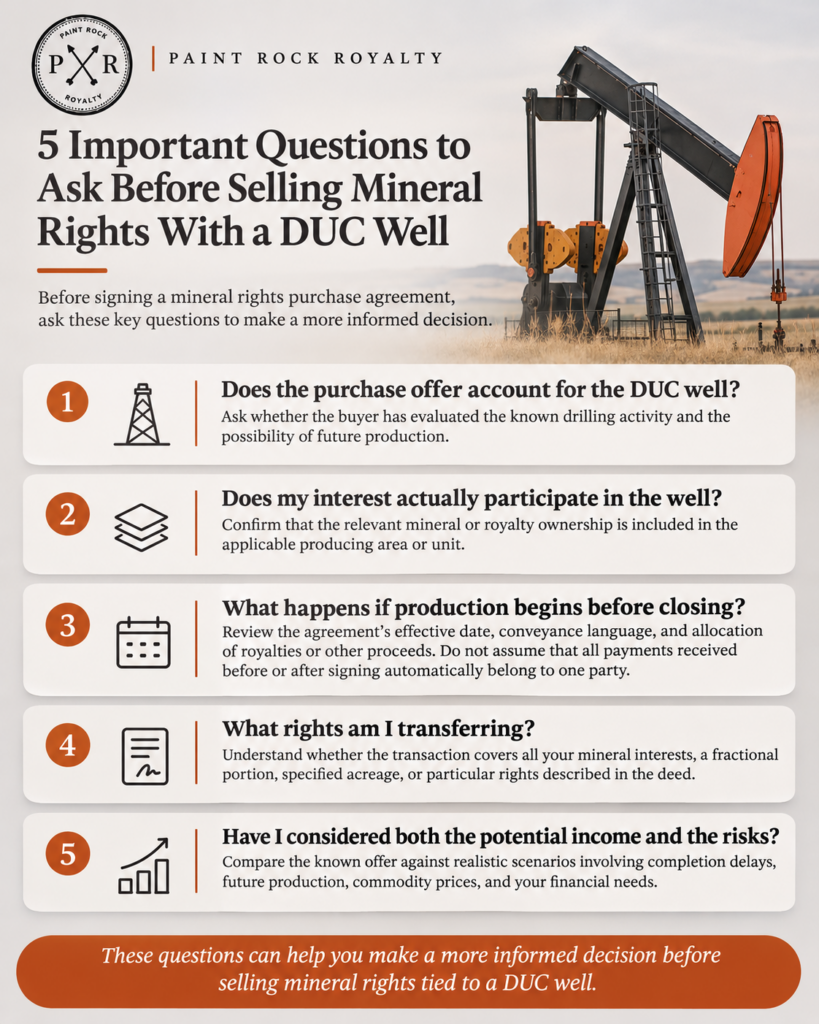
Five Important Questions to Ask Before Selling Mineral Rights With a DUC Well
Can You Sell Only Part of Your Mineral Rights Before Production?
Depending on your ownership and the terms a buyer is willing to accept, it may be possible to sell only a portion of your mineral interests.
For example, an owner might consider selling a fractional interest while retaining the remaining ownership.
This could provide some immediate liquidity while preserving participation in potential future royalty income on the retained interest.
However, a partial sale permanently reduces the rights and potential income transferred, and not every buyer or transaction structure will be suitable.
Mineral owners should review the deed and purchase agreement carefully to understand exactly what is being conveyed.
How Paint Rock Royalty Can Help You Evaluate Your Mineral Rights
Deciding whether to sell before a DUC well begins producing can be difficult because the asset’s future performance remains uncertain.
At Paint Rock Royalty, mineral owners can explore options for selling their oil and gas mineral interests.
The company’s published selling process includes ownership-document research, due diligence, verification of tract ownership, and review of a proposed Mineral & Royalty Deed.
For owners with a DUC well affecting their acreage, understanding the interest being sold is particularly important because potential future production can be part of the valuation discussion.
A mineral rights offer can provide a concrete figure to compare against the uncertain value of future royalties.
Learn more about selling mineral rights with Paint Rock Royalty.
If you own unleased mineral rights and want to explore retaining ownership, you can also review PRR’s information about leasing oil and gas mineral rights. Existing leases and their terms may limit your ability to grant another lease.
Should You Sell Mineral Rights Before a DUC Well Produces?
A DUC well can indicate that oil and gas development has progressed beyond the planning stage. For mineral owners, that can be meaningful information when evaluating the future potential of their property.
However, a drilled well is not the same as a producing well, and expected royalties are not guaranteed income.
Selling before production may make sense when you value an agreed lump-sum payment and want to reduce uncertainty.
Waiting may be preferable if you want to retain ownership and are comfortable with the possibility of completion delays, variable production, or changing market conditions.
Before making a decision, confirm whether your interest participates in the well, review publicly available development records, and compare your options using realistic assumptions.
Find Out What Your Mineral Rights May Be Worth
If your mineral acreage is associated with a DUC well, you do not necessarily need to wait for first production before exploring a potential sale.
Paint Rock Royalty offers mineral owners the opportunity to request a no-obligation purchase offer and learn more about the selling process.
Request a No-Obligation Mineral Rights Offer From Paint Rock Royalty
Explore your options, understand your ownership, and make an informed decision about the future of your mineral rights.
Frequently Asked Questions
What Does DUC Mean in Oil and Gas?
DUC stands for drilled but uncompleted. A DUC well is an oil or natural gas well that has been drilled but has not completed the operations needed to prepare it for production. Operators may delay completion because of market conditions, scheduling, infrastructure, or financial priorities.
Does a DUC Well Increase Mineral Rights Value?
A DUC well may increase the perceived development potential of mineral rights because drilling has already occurred. However, it does not guarantee higher property value, successful production, or future royalty income. Buyers consider completion uncertainty, ownership participation, estimated production, and market conditions when evaluating the interest.
Can You Sell Mineral Rights Before a DUC Well Starts Producing?
Yes. Mineral owners may be able to sell their interests before a DUC well begins producing. A buyer may consider the property’s development potential when making an offer. The transaction depends on valid ownership, acceptable title, and agreement on the rights and purchase terms.
4. Do Mineral Owners Receive Royalties From DUC Wells?
A DUC well generally does not generate production royalties from that particular well because it has not started producing. Royalty payments may become available if the well is completed, produces and markets oil or gas, and the owner’s interest qualifies for payment. Other producing wells may already generate royalties on the same acreage.
Is It Better to Sell Mineral Rights Before or After Production Begins?
There is no universally better time to sell. Selling before production may provide immediate liquidity and reduce exposure to uncertainty. Waiting may allow the owner to benefit from future royalties and obtain actual production data, but the well could be delayed or underperform. The right choice depends on the offer, property characteristics, risk tolerance, and financial objectives.
