


Why Multiple Mineral Rights Offers Need Careful Review
Selling mineral rights can feel exciting, confusing, and stressful at the same time. When several mineral rights buyer offers arrive, the highest number may look like the obvious winner. However, the best offer is not always the biggest offer on paper. A smart mineral rights offer comparison looks at value, terms, timing, risk, buyer reputation, and long-term impact.
If you want to compare mineral rights offers with confidence, you need a clear process. This guide explains how to evaluate multiple mineral rights offers, understand valuation factors, avoid lowball mineral rights offers, and choose a fair mineral rights offer with less uncertainty.
Getting competing mineral rights offers is usually a good sign. It means buyers see potential value in your ownership. However, each buyer may calculate value differently based on production history analysis, nearby drilling activity, oil and gas price trends, lease terms, and risk.
Some buyers focus on current royalty income. Others value future drilling upside. Meanwhile, some buyers may use vague terms, fast deadlines, or offer contingencies that reduce your final payout. Therefore, a proper mineral rights offer evaluation should compare more than the cash amount.
A good review helps you answer three important questions.
- Is the offer based on accurate ownership information
• Are the purchase agreement terms clear and fair
• Does the buyer have a transparent process and strong reputation
When you understand these points, you can sell mineral rights for fair value instead of guessing.
Key Factors Buyers Use to Calculate Mineral Rights Offers
Before you accept a mineral rights cash offer, it helps to know how buyers estimate value. A mineral rights valuation comparison usually includes several technical and market based factors.
1. Net Mineral Acres Calculation
Your net mineral acres calculation is one of the first items buyers review. It measures your actual ownership after accounting for tract size and ownership percentage. If this calculation is wrong, the offer may also be wrong.
For example, owning part of a 100 acre tract does not mean you own 100 net mineral acres. Your exact share depends on title records, deeds, probate documents, and ownership history.
2. Royalty Interest Percentage
The royalty interest percentage affects how much income you receive from production. A higher royalty percentage usually increases the value of your minerals. However, buyers also examine whether the royalty is burdened by lease terms, deductions, or other obligations.
3. Lease Terms and Royalty Rate
Lease terms and royalty rate can greatly influence value. A favorable lease may include stronger royalty terms, better operator obligations, and clearer payment language. On the other hand, older leases may contain terms that reduce net income.
4. Production History Analysis
Buyers study past and current production to estimate future cash flow. Strong production history may support a better offer. Still, declining wells, limited activity, or uncertain reserves can affect pricing.
5. Nearby Drilling Activity
Nearby drilling activity can increase buyer interest, especially in active oil and gas regions. If operators are drilling close to your minerals, future development may be possible. Consequently, your minerals may carry more upside than current income alone suggests.
6. Oil and Gas Price Trends
Oil and gas price trends affect the market value of mineral rights. When prices rise, buyers may become more aggressive. When prices fall, buyers may price more cautiously. This is why timing can influence mineral rights buyer offers.
Mineral Rights Offer Comparison Table
Use this table to organize your review before signing anything.
Review Area | What to Check | Why It Matters |
Cash price | Total purchase price and payment method | Shows the immediate financial value |
Net mineral acres | Buyer calculation and supporting records | Prevents undervaluing your ownership |
Royalty interest percentage | Royalty rate and decimal interest | Confirms income potential |
Lease status | Active lease terms and royalty rate | Affects future revenue and obligations |
Production history | Current income and well decline trends | Helps estimate future cash flow |
Nearby activity | Drilling permits and operator movement | Reveals possible upside |
Title review | Title verification process and required documents | Reduces closing delays |
Contract terms | Purchase agreement terms and contingencies | Protects your final payout |
Closing process | Closing timeline and escrow details | Improves certainty and payment safety |
Buyer quality | Buyer reputation and transparency | Reduces risk during the sale |
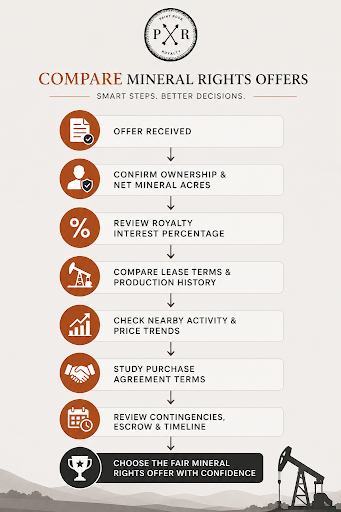
What to Check Before Accepting a Mineral Rights Offer
A strong mineral rights offer checklist should protect you from rushed decisions. Before accepting any offer, review the money, documents, buyer behavior, and closing process.
Check the True Purchase Price
Some offers look attractive at first but change after due diligence review. Ask whether the price is firm or subject to title verification, acreage adjustments, production checks, or other offer contingencies.
If the buyer can reduce the price later, understand exactly why and when that can happen. Also ask how adjustments will be calculated.
Review the Purchase Agreement Terms
The purchase agreement terms matter as much as the offer amount. Look for language about what is being sold, when payment happens, how title problems are handled, and whether the buyer can cancel.
Pay attention to these items.
- Property description
• Purchase price
• Effective date
• Closing timeline and escrow process
• Representations and warranties
• Offer contingencies
• Mineral deed transfer language
• Responsibility for unpaid taxes or suspended funds
A trusted mineral rights buyer should explain these terms clearly.
Understand the Title Verification Process
The title verification process confirms that you own what you are selling. Buyers may request deeds, division orders, probate records, lease documents, tax statements, or royalty check details.
This step is normal. However, it should be handled professionally. You should know what documents are required, how long review may take, and how findings may affect the final offer.
Confirm the Closing Timeline and Escrow
A reliable closing process creates confidence. Ask when documents will be signed, when funds will be available, and whether escrow will be used. Escrow can help protect both sides because payment and mineral deed transfer are handled through a structured process.
How to Know if a Mineral Rights Offer Is Fair
A fair mineral rights offer should make sense when compared with your ownership, income, market conditions, and future upside. It should also come from a buyer who communicates openly.
Here are signs of a fair offer.
- The buyer explains how value was calculated
• The offer reflects current production and future potential
• The agreement does not hide unreasonable contingencies
• The closing timeline is clear
• The buyer answers questions without pressure
• The final price is supported by comparable offers
Therefore, the best way to evaluate competing mineral rights offers is to compare both numbers and terms. A slightly lower offer from a transparent buyer may be better than a higher offer with unclear conditions.
How to Avoid Undervaluing Mineral Rights
Many owners undervalue their minerals because they rely on one offer. Instead, get multiple mineral rights offers and compare mineral rights buyers before selling. This gives you a stronger view of market demand.
You should also avoid emotional pressure. Some buyers may create urgency by saying the offer expires quickly. However, a major financial decision deserves careful review.
To avoid undervaluing mineral rights, follow these steps.
- Gather recent royalty statements
• Confirm your ownership records
• Review active lease documents
• Ask buyers to explain valuation assumptions
• Compare cash price and contract terms
• Research buyer reputation and transparency
• Consider mineral rights appraisal Texas support when needed
If your minerals are in Texas, search terms like best mineral rights buyers Texas, mineral rights appraisal Texas, and trusted mineral rights buyers can help you identify experienced professionals. Still, always compare more than marketing claims.
Common Mistakes Sellers Should Avoid
Sellers often make avoidable mistakes when reviewing multiple mineral rights offers. The biggest mistake is accepting the first offer without understanding the market. Another mistake is focusing only on the headline price.
You should also avoid signing documents before reviewing the legal and financial details. A mineral deed transfer is a serious transaction. Once completed, you may give up future royalty income, bonus payments, and drilling upside.
Finally, do not ignore buyer reputation. A good buyer should be transparent, responsive, and willing to explain the process. If communication feels unclear before closing, it may not improve later.
Mineral Rights Offer Comparison Checklist
Use this checklist before moving forward.
- Did I receive more than one offer
• Did each buyer confirm the same net mineral acres calculation
• Did I compare the royalty interest percentage used by each buyer
• Did I review lease terms and royalty rate
• Did I examine production history analysis
• Did I consider nearby drilling activity
• Did I factor in oil and gas price trends
• Did I understand all offer contingencies
• Did I review the purchase agreement terms
• Did I confirm the closing timeline and escrow process
• Did I check buyer reputation and transparency
• Did I understand the mineral deed transfer
This mineral rights offer comparison checklist can help you move from uncertainty to informed decision making.
Final Thoughts
Learning how to compare multiple mineral rights offers can protect your financial future. The goal is not only to secure a strong price. The goal is to choose the offer with fair value, clear terms, reliable closing steps, and a buyer you can trust.
If you want to evaluate mineral rights offer options properly, take your time, ask direct questions, and compare each detail carefully. A confident decision comes from understanding both the value of your minerals and the quality of the buyer.
Ready to Compare Your Offers With Confidence?
Your mineral rights may be worth more than a quick offer suggests. Before you sign, take a closer look at the numbers, the terms, and the buyer behind the proposal.
Connect with Paint Rock Royalty to discuss your mineral rights, review your options, and explore a fair path forward. Bring your offers, ask your questions, and make your next decision with clarity.
Frequently Asked Questions
How do buyers calculate mineral rights offers?
Buyers usually consider net mineral acres, royalty interest percentage, lease terms, production history, nearby drilling activity, commodity prices, and title risk. Each buyer may weigh these factors differently.
How do I know if a mineral rights offer is fair?
A fair mineral rights offer should reflect your ownership, current royalty income, future drilling potential, and market conditions. It should also include clear terms and limited hidden contingencies.
Should I get multiple mineral rights offers before selling?
Yes. Getting multiple mineral rights offers helps you understand market value and avoid lowball mineral rights offers. It also gives you leverage when comparing buyers.
What should I check before accepting a mineral rights offer?
Check the cash price, net mineral acres calculation, purchase agreement terms, title verification process, offer contingencies, closing timeline, escrow details, and buyer reputation.
What is the best way to evaluate competing mineral rights offers?
The best way is to compare price, terms, risk, buyer transparency, and closing certainty together. A complete mineral rights valuation comparison is stronger than judging offers by price alone.