

Selling mineral rights does not always require choosing between keeping everything and selling your entire ownership interest. Mineral owners can sometimes sell only a portion while retaining exposure to future royalties and development.
Therefore, many owners eventually ask, can I sell part of my mineral rights and keep the rest? In many situations, a partial mineral rights sale may provide greater flexibility than selling everything.
However, the best choice depends on your financial goals, ownership details, production history, development potential, and tolerance for future uncertainty. Understanding each option can help you decide whether to sell all or part of mineral rights with greater confidence.
Can I Sell Part of My Mineral Rights?
Yes, mineral owners can often sell a percentage of their mineral interest rather than transferring the entire ownership position. The exact structure depends on the property, ownership records, transaction terms, and applicable legal requirements.
For example, an owner might sell fifty percent of an interest while keeping the remaining fifty percent. Another owner could sell interests covering specific acreage while retaining minerals beneath other property.
A partial mineral rights sale can create immediate cash while allowing the owner to retain some future royalty potential. Therefore, partial sales can appeal to owners who want liquidity without completely leaving their mineral investment.
However, every transaction should clearly identify what is being sold and what remains with the owner.
How Does a Partial Mineral Rights Sale Work?
When you sell part of mineral rights, the transaction usually transfers a defined percentage or portion of your ownership. The deed and purchase agreement should describe that transferred interest accurately.
For example, suppose you own one hundred percent of your mineral interest beneath a particular tract. You might decide to sell forty percent while retaining sixty percent.
After closing, future income associated with the transferred portion generally belongs to the buyer. Meanwhile, you continue owning the percentage that you retained.
The basic process usually involves:
- Confirming your ownership and net mineral acres
- Reviewing existing oil and gas leases
- Determining whether the minerals currently produce royalties
- Choosing how much of the interest you want to sell
- Receiving and evaluating an offer
- Reviewing the purchase agreement and deed carefully
- Completing title verification before closing
Therefore, a partial sale requires careful documentation because small wording differences can affect valuable property rights.
Selling All Versus Selling Part of Your Mineral Rights
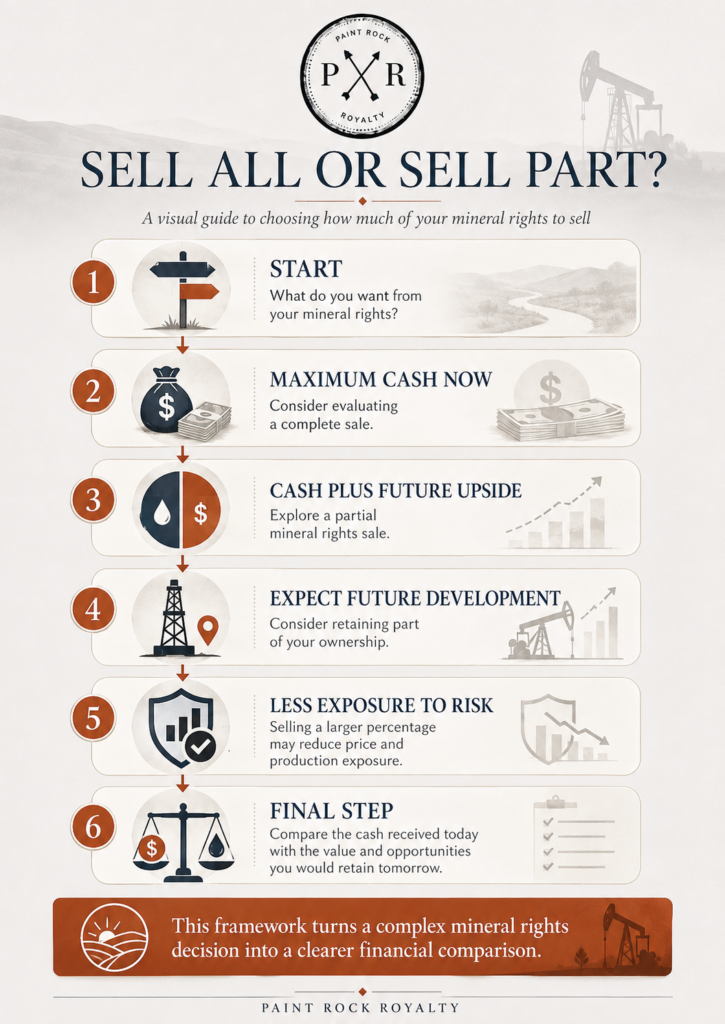
Choosing whether to sell all or part of mineral rights usually involves balancing immediate cash with future participation. Selling everything can provide more liquidity today while reducing exposure to future production uncertainty.
In contrast, selling only part may provide cash while preserving some future income and development potential.
|
Decision Factor |
Sell All |
Sell Part |
|
Immediate cash |
Usually higher |
Usually lower |
|
Future royalty potential |
Usually transferred |
Partially retained |
|
Future drilling exposure |
Usually transferred |
Partially retained |
|
Commodity price exposure |
Greatly reduced |
Partially retained |
|
Ownership management |
Simpler after sale |
Continues for retained interest |
|
Financial flexibility |
Higher immediate liquidity |
Balance of cash and ownership |
Neither approach is automatically better. Instead, the right decision depends on what you want your mineral interest to accomplish financially.
Why Would Someone Sell Only Part of Their Mineral Rights?
Owners choose a partial mineral rights sale for several reasons. Most importantly, the strategy can create balance between immediate liquidity and future opportunity.
For example, an owner may need cash for retirement but still want exposure to future drilling. Another owner may want to diversify wealth without giving up every mineral interest.
A partial sale may also appeal when family members prefer keeping some mineral ownership for future generations.
Common reasons include:
- Creating cash without selling the entire asset
- Reducing exposure to oil and natural gas price changes
- Retaining some future royalty income
- Preserving possible benefits from additional drilling
- Diversifying personal investments
- Simplifying part of an inherited mineral portfolio
Therefore, selling only a portion can serve as a middle option between keeping everything and selling everything.
Should I Sell All My Mineral Rights?
Selling the entire mineral interest can make sense when immediate liquidity is more important than uncertain future royalties. It may also simplify ownership responsibilities.
For example, inherited minerals can sometimes involve complicated records, multiple operators, small royalty payments, or interests across several counties. Selling everything may reduce future administrative responsibilities in these situations.
Additionally, some owners prefer moving concentrated mineral wealth into other investments. Selling may provide greater control over how that capital is used.
However, a complete sale generally means giving up future economic benefits associated with the transferred interest. Consequently, future drilling or stronger production may benefit the new owner instead.
Before selling everything, compare the offer against realistic expectations for future income and development.
Should I Sell Half of My Mineral Rights?
Many owners specifically ask whether they should sell half of mineral rights while keeping the remaining portion. A fifty percent sale is easy to understand but does not automatically represent the ideal percentage.
Instead, decide how much cash you actually need and how much future exposure you want to retain.
For example, suppose your entire mineral interest receives an attractive $200,000 valuation. Selling half could potentially provide meaningful liquidity while preserving half of your ownership.
However, actual pricing can depend on transaction details and buyer valuation methods. Therefore, do not assume every percentage will receive identical pricing per ownership unit.
The percentage should support your financial objective rather than simply provide a convenient number.
What Happens to Royalties After a Partial Sale?
Royalty income becomes especially important when selling producing mineral rights. A partial sale generally means future economic benefits are divided according to the ownership transferred and retained.
For example, selling fifty percent of a producing mineral interest may reduce your future royalty participation accordingly. However, the exact result depends on the ownership structure and transaction documents.
Therefore, review recent royalty statements before making your decision. Understanding current income helps you evaluate what you may be giving up.
Also, consider whether production has been rising or declining. Current royalty payments should not automatically be treated as permanent future income.
Future wells can increase payments while declining production can reduce them. Consequently, both possibilities belong in your financial analysis.
How Are Partial Mineral Rights Valued?
A mineral rights valuation Texas owners receive can depend on many property-specific factors. Buyers do not simply assign one statewide price to every mineral acre.
Important valuation factors may include:
- Net mineral acres
- Royalty percentage
- Existing production
- Recent royalty income
- Oil and gas lease terms
- Nearby drilling activity
- Operator quality and activity
- Development potential
- Commodity price expectations
- Title condition
Therefore, the value of a partial interest may depend on much more than the percentage being sold.
If you are asking how much my mineral rights are worth, a property-specific evaluation provides more useful information than broad averages.
Selling Part of Mineral Rights in Texas
Owners researching how to sell part of mineral rights in Texas properties should begin by understanding their recorded ownership. Texas mineral interests can involve separate mineral estates, royalty interests, leases, inherited interests, and divided ownership.
Therefore, accurate records become especially important before requesting or accepting an offer.
Gather any mineral deeds, leases, division orders, royalty statements, probate documents, and ownership records available to you. These documents can help clarify what you own and what could potentially be sold.
Additionally, compare the proposed purchase terms instead of focusing only on the total payment.
A strong cash offer for mineral rights Texas owners receive should be evaluated alongside retained value, transaction terms, and future expectations.
Questions to Ask Before Selling Any Percentage
Before signing a mineral sale agreement, understand exactly what the buyer wants and what ownership you will retain.
Ask these questions before moving forward:
- What percentage of my mineral interest am I selling?
- Which acreage, formations, or interests does the agreement cover?
- What royalty interest will I retain after closing?
- Can the purchase price change after title review?
- What happens if additional wells are drilled later?
- Does the deed match the terms described in the offer?
- When will payment occur?
Careful review can prevent misunderstandings after ownership has permanently changed.
Which Option Fits Your Financial Goals?
The decision to sell mineral rights and keep some should begin with your personal objectives. A complete sale may work when certainty and immediate liquidity matter most.
Meanwhile, a partial sale can help balance present needs with potential future income. Keeping everything may remain attractive when you prefer continuing royalty exposure and future development opportunities.
Therefore, compare several realistic scenarios rather than treating the decision as strictly all or nothing.
Your mineral rights are a financial asset. The best structure should support your broader plans for income, investment, family wealth, and financial flexibility.
Ready to Explore What Selling Part Could Look Like?
You do not have to decide between keeping every mineral interest and selling everything at once.
What if you could compare several options before choosing?
Consider what selling twenty-five percent, fifty percent, or your entire interest could mean for your financial goals.
Paint Rock Royalty can help you review your mineral interest and explore potential sale options based on your property.
Keep more. Sell more. Or find the balance that works for you.
Request a no-obligation evaluation from Paint Rock Royalty and compare your choices before making a permanent ownership decision.
Frequently Asked Questions
Can I sell part of my mineral rights and keep the rest?
Yes, owners can often transfer a defined portion while retaining the remaining mineral interest. Transaction documents should clearly describe both portions.
Can I sell half of my mineral rights?
A fifty percent mineral sale may be possible depending on your ownership. However, choose the percentage based on your financial objectives.
What happens to my royalties if I sell only part of my mineral rights?
Future royalties generally reflect the ownership you retain. However, the exact result depends on lease terms and transaction documents.
Is it better to sell all or part of mineral rights?
Neither choice is universally better. Compare immediate cash, future royalties, drilling potential, financial goals, taxes, and your tolerance for uncertainty.
Can I sell part of my mineral rights in Texas?
Texas mineral owners can often sell partial interests. However, ownership records and transaction documents should be carefully reviewed before completing a sale.