


Oil and gas royalties create long-term income for many mineral owners. However, production does not continue forever. Every well reaches a stage where output declines or stops completely. At that point, many owners begin asking important questions about royalties when a well stops producing.
Do royalty payments end immediately? Can the well produce again later? What rights do mineral owners still have after production slows down?
Understanding the answer is essential because production changes can affect your income, lease status, and future opportunities. In many cases, mineral owners still retain valuable assets even after a well becomes inactive.
This guide explains what happens to royalty payments when a well stops producing and what mineral owners should know about protecting their interests.
Understanding Why Oil Wells Stop Producing
Every oil and gas well has a natural production lifecycle. Most wells produce heavily during the early years. After that, output gradually declines due to depletion of oil reserves and lower underground pressure.
Several factors can cause an oil well to stop producing royalties, including:
Reason for Production Stop | Explanation |
Declining oil production rates | Natural reduction in output over time |
Mechanical issues | Equipment failure or damaged infrastructure |
Market conditions | Low oil prices may pause operations |
Temporary well shutdowns | Operators may suspend activity temporarily |
Plugged and abandoned wells | Wells were permanently closed after depletion |
Regulatory concerns | Environmental or legal restrictions |
When production falls below profitable levels, operators may shut in the well or abandon it completely.
What Happens to Royalty Payments When a Well Stops Producing?
The most immediate impact involves income interruption. In most cases, royalty checks stop once production ends because royalties depend on active oil or gas sales.
If the oil well stops producing royalties permanently, mineral owners usually stop receiving monthly or quarterly payments. However, this does not always mean your mineral rights lose value.
Several outcomes are possible after production stops:
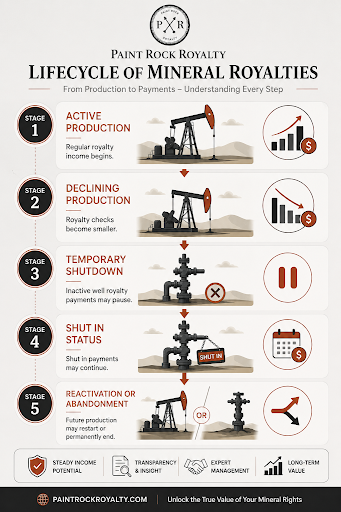
1. Royalty Payments May Pause Temporarily
Sometimes operators shut in wells temporarily due to maintenance, pricing issues, or pipeline limitations. During this period, production stops, but the well remains operational.
This situation often leads to suspended royalty payments that oil and gas owners experience during inactive periods.
In these cases:
- Payments stop temporarily
- The lease may remain active
- Production can restart later
- Future royalties may resume
Many mineral owners ask, “Do mineral owners still get paid after production stops?” The answer depends on the lease agreement and operational status of the well.
2. Shut In Royalty Payments May Apply
Many oil and gas leases include a shut-in clause explained within the contract terms. This clause allows operators to maintain the lease even when production pauses temporarily.
Under a shut-in agreement:
- The operator pays a small annual fee
- Mineral rights remain leased
- The operator keeps future production rights
- Royalty owners receive limited compensation
These shut in well royalty rights vary depending on state laws and lease language.
Although shut-in payments are smaller than production royalties, they help preserve the lease during temporary inactivity.
Producing vs. Non-Producing Wells
Understanding the difference between active and inactive wells helps mineral owners evaluate future opportunities.
Producing Wells | Non-Producing Wells |
Generate regular royalties | No active royalty income |
Actively extract oil or gas | Production paused or ended |
Maintain consistent operations | May be shut in or abandoned |
Higher market value | Value depends on future potential |
Non-producing oil well royalties usually disappear once production stops. However, the mineral rights themselves often remain valuable.
Can Inactive Wells Start Producing Again?
One of the most common questions mineral owners ask is, “Can inactive wells start producing again?”
The answer is yes.
Many inactive wells regain production due to:
- Improved oil prices
- New drilling technology
- Enhanced recovery methods
- Infrastructure upgrades
- Operator changes
Well reactivation potential depends on the geology and remaining reserves. Some older wells become profitable again years after inactivity.
This possibility is why buyers continue to evaluate the value of inactive wells in areas with long-term production history.
What Happens to Mineral Royalties After Production Stops?
Even when royalty income ends, mineral owners still retain ownership rights unless they sell them.
Here is what typically happens to mineral royalties after production stops:
Ownership Continues
Mineral owners usually continue owning their minerals indefinitely unless transferred or sold.
Future Leasing Opportunities May Exist
If a lease expires after production stops, owners may negotiate new lease agreements with other operators.
New Wells Could Be Drilled
Operators sometimes develop deeper formations or nearby reserves later.
Property Value May Change
The market value of mineral rights often declines after production stops, but location and future drilling potential still matter.
Oil and Gas Lease Obligations After Production Stops
Lease agreements play a major role in determining what happens next.
Operators must follow specific oil and gas lease obligations even after production slows down.
These obligations may include:
- Proper maintenance
- Environmental compliance
- Timely communication
- Shut in compensation
- Well-plugging procedures
If a lease expires due to non-production, mineral owners may regain full leasing control.
Reviewing lease language carefully helps owners understand their rights during royalty payment delays.
Plugged and Abandoned Wells Explained
When a well no longer has economic value, operators may permanently close it.
Plugged and abandoned wells undergo a sealing process designed to protect groundwater and environmental safety.
After abandonment:
- Production permanently stops
- Royalty income ends
- Lease rights may terminate
- Mineral ownership remains intact
However, nearby formations may still hold future drilling opportunities.
Should You Sell Non-Producing Mineral Rights?
Some owners decide to sell non-producing mineral rights after production declines.
Others choose to hold them for future appreciation.
The best decision depends on several factors:
- Future drilling activity
- Local market demand
- Lease status
- Existing shut-in agreements
- Regional production trends
Many owners seek professional oil and gas royalty analysis before deciding.
Reasons Owners Sell
- Immediate cash needs
- Estate planning
- Income uncertainty
- Simplified asset management
Reasons Owners Hold
- Future reactivation potential
- New drilling technology
- Long-term appreciation
- Family inheritance goals
Professional companies like Paint Rock Royalty help owners evaluate inactive well value and understand available options.
You can learn more about their services here:
How Mineral Rights Appraisal Works
A mineral rights appraisal that Texas owners receive often considers:
Evaluation Factor | Importance |
Historical production | Shows past profitability |
Nearby drilling activity | Indicates future potential |
Remaining reserves | Estimates future production |
Lease terms | Affects ownership flexibility |
Commodity prices | Influences market demand |
Even non-producing properties may attract buyers if regional development remains active.
Signs Your Inactive Mineral Rights May Still Have Value
Not all inactive wells are worthless. Several indicators may suggest future opportunities.
Watch for These Signs
- New permits nearby
- Expanding pipeline systems
- Increased leasing activity
- Rising oil prices
- Technological advancements
Understanding how shut-in wells affect royalty income helps owners make informed financial decisions.
What Mineral Owners Should Know About Non-Producing Wells
Mineral ownership involves long-term planning. Production declines are common, but they do not always eliminate future opportunities.
Owners should:
- Review lease agreements carefully
- Track operator communication
- Monitor nearby drilling activity
- Understand shut-in clauses
- Seek professional valuation guidance
Staying informed allows owners to protect their assets and maximize future value.
Protect the Value of Your Mineral Rights Today
Even when royalties from a well that stops producing become uncertain, your mineral rights may still hold significant value. Understanding your lease, production status, and future opportunities can help you make smarter financial decisions.
Paint Rock Royalty works with mineral owners across Texas to provide expert guidance, transparent evaluations, and fair offers for producing and non-producing mineral rights.
Whether you want to evaluate inactive well value, explore future royalty opportunities, or sell non-producing mineral rights, their experienced team can help you move forward confidently.
Visit these resources to learn more:
Frequently Asked Questions
What happens to royalty payments when a well stops producing?
Royalty payments usually stop when production ends because income depends on oil or gas sales. However, shut-in payments may continue temporarily.
Do mineral owners still get paid after production stops?
Sometimes. If the lease contains a shut-in clause, owners may receive limited payments while the well remains inactive.
Can inactive wells start producing again?
Yes. Improved technology, higher oil prices, and new operators can reactivate inactive wells.
What are shut-in well royalty rights?
These rights allow operators to maintain lease control by making small payments during temporary production interruptions.
Should I sell non-producing mineral rights?
The decision depends on your financial goals, local drilling activity, and future production potential. Professional evaluations can help determine fair value.