
Understanding a mineral rights offer valuation can feel overwhelming because the math often stays hidden behind simple purchase numbers. Many owners receive offers without knowing how buyers calculate value or adjust for uncertainty.
This guide explains the financial logic behind mineral rights pricing using clear language and practical examples. By the end, you will better understand how offers are built and how to judge them confidently.
Why Mineral Rights Valuation Is More Than a Guess
A mineral rights offer valuation is not a random estimate or a quick opinion from a landman. It is a structured financial process that combines production data, market assumptions, and risk analysis. Buyers aim to predict future royalty income and convert it into a present-day value. Therefore, every offer reflects expectations about oil and gas price, as well performanc,e and operational risks.
However, not all models are equal in quality or transparency. Some buyers rely on conservative assumptions while others apply aggressive pricing to win deals. Knowing the math helps you recognize fair value and avoid undervaluation. For sellers, this knowledge creates leverage during negotiations.
The Role of Present Value in Royalty Income
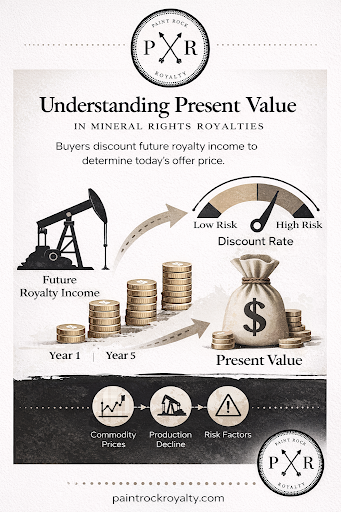
The present value of royalty income is the foundation of any mineral rights offer valuation. Buyers do not pay for total future revenue. Instead, they discount future cash flows to reflect time and uncertainty. A dollar earned ten years from now is worth less than a dollar earned today.
This concept explains why long-producing wells still trade at lower multiples. Even stable royalties lose value over time due to declining production and market volatility. Therefore, present value calculations drive every serious mineral rights offer pricing model.
How Present Value Is Calculated
Buyers estimate monthly or annual royalty income over the expected life of the well. They then apply a discount rate to convert future payments into current value. The sum of these discounted payments becomes the offer price before adjustments.
The table below shows a simplified example.
Year | Expected Royalty Income | Discounted Value |
1 | 12000 | 10900 |
5 | 9000 | 6700 |
10 | 5000 | 3100 |
Although the total future income looks attractive, the present value is much lower. This difference explains why offers often surprise mineral owners.
Discount Rates and Why They Matter
The discount rate mineral rights valuation reflects risk tolerance and opportunity cost. Higher discount rates reduce present value while lower rates increase it. Buyers choose rates based on commodity price risk operational uncertainty and capital costs.
Most mineral buyers use discount rates between eight percent and twenty-five percent. A conservative buyer may choose a higher rate to protect against downside risk. Meanwhile a competitive buyer may accept a lower rate to secure the asset.
What Influences Discount Rate Selection
Several factors shape discount rate assumptions.
- Commodity price volatility and market cycles
- Operator quality and drilling track record
- Remaining reserves and production stability
- Legal or title risks tied to the minerals
Each factor adds perceived risk which increases the discount rate. As a result two buyers may value the same minerals very differently.
Decline Curve Analysis and Production Forecasting
Decline curve analysis of oil and gas royalties relies on historical production data to predict future output. Oil and gas wells usually produce less over time due to reservoir depletion. Decline curves model this reduction using mathematical formulas.
Accurate decline analysis improves forecast reliability. Poor analysis leads to unrealistic expectations and distorted mineral rights offer valuation. Buyers often apply conservative decline assumptions to protect capital.
Common Decline Curve Types
The most used decline models include exponential hyperbolic and harmonic curves. Each reflects different reservoir behaviors and production patterns.
Decline Type | Typical Use Case | Risk Level |
Exponential | Mature stable wells | Low |
Hyperbolic | Shale and unconventional wells | Medium |
Harmonic | Early high decline wells | High |
Understanding which curve applies to your property helps explain buyer assumptions and pricing.
Risk-Adjusted Mineral Rights Value Explained
Risk-adjusted mineral rights value reflects uncertainty beyond production decline. Even strong wells face risks such as price crashes regulatory changes and operator financial stress. Buyers reduce value to compensate for these unknowns.
Risk adjustments may include probability weighting or higher discount rates. Some buyers also cap upside potential while fully accounting for downside scenarios. This approach protects investors but can reduce seller proceeds.
Key Risks Buyers Consider
- Oil and gas price fluctuations
- Future drilling delays or cancellations
- Lease expiration and spacing changes
- Environmental and regulatory exposure
Each risk lowers the certainty of future income. Therefore risk-adjusted models usually produce lower offers than simple income multiples.
How Mineral Rights Offer Pricing Models Come Together
A mineral rights offer pricing model integrates present value discount rates decline curves and risk adjustments. These components work together rather than separately. Changing one assumption affects the entire valuation.
For example a lower discount rate may be offset by a steeper decline curve. Similarly strong production history may reduce perceived risk. Buyers fine-tune models to balance competitiveness with capital protection.
Why Offers Vary Between Buyers
Mineral owners often ask why offers differ so widely. The answer lies in assumptions rather than mistakes. Each buyer uses different pricing models risk tolerance, and investment goals. Some prioritize long-term cash flow while others seek quick returns.
Companies like Paint Rock Royalty focus on transparent evaluations and fair pricing. Our approach helps owners understand how offers are formed and why numbers look the way they do.
You can learn more about selling mineral rights at https://paintrockroyalty.com/selling-mineral-rights.
How Knowledge Improves Negotiation Outcomes
Understanding mineral rights offers valuation and empowers owners during negotiations. When you recognize discount rate assumptions or decline curve choices you can challenge overly conservative models. Knowledge also helps you compare offers objectively.
Instead of focusing only on the final number, consider the logic behind it. Ask buyers about discount rates production forecasts and risk assumptions. Serious buyers will explain their approach clearly.
Choosing the Right Partner for Your Minerals
You deserve clarity, confidence,e and fair compensation for your
Not all buyers operate with the same transparency or ethics. Working with a reputable firm ensures fair treatment and accurate valuation. Paint Rock Royalty emphasizes education clarity, and owner trust.
A trusted partner values long-term relationships rather than quick deals. This mindset often leads to better pricing and smoother transactions.
mineral assets. Take control by comparing offers thoughtfully and strategically. Explore trusted insights and transparent options by visiting paintrockroyalty.com today. Empower yourself with knowledge and turn competing offers into your strongest advantage.
A Confident Step Toward Smarter Decisions
Mineral rights decisions shape long-term financial outcomes and deserve careful thought. When you understand the hidden math behind offers you gain confidence and control. Instead of guessing you evaluate facts and assumptions.
If you want a transparent mineral rights offer valuation from professionals who respect your ownership, visit https://paintrockroyalty.com today. Explore your options ask informed questions and take the next step with clarity and confidence. Your minerals have value and you deserve to understand it fully.
Frequently Asked Questions
What is a mineral rights offer valuation?
It is a financial estimate of what your mineral rights are worth today based on future royalty income and risk.
How does the discount rate affect my offer?
Higher discount rates reduce present value while lower rates increase it, depending on perceived risk.
Why do decline curves matter so much?
They predict future production, which directly impacts expected royalty income and valuation
Can I negotiate a higher valuation?
Yes, informed owners can negotiate by questioning assumptions and comparing multiple offers.
Should I accept the first offer I receive?
It is usually wise to review several offers and understand the valuation logic before deciding.