


Understanding mineral rights vs royalty rights is essential for landowners, investors, and anyone involved in oil and gas ownership decisions today. Many people assume both terms mean the same thing, yet they represent distinct ownership structures with different financial outcomes and responsibilities. This guide explains the difference between mineral rights and royalty rights in clear terms while helping you make informed decisions about buying, selling, or managing your assets.
What Are Mineral Rights
Mineral rights refer to the legal ownership of subsurface resources such as oil, gas, coal, or other valuable minerals beneath a piece of land. When you own mineral rights, you control exploration, leasing, and production activities associated with those resources.
Mineral rights explained for landowners often include several important components:
- The right to lease the minerals to an operator
- The ability to receive lease bonus payments
- The option to collect royalties from production
- The authority to sell or transfer ownership
Moreover, mineral ownership can exist separately from surface ownership, which leads to the concept of surface rights vs mineral rights. A landowner may own the surface but not the minerals beneath it.
What Are Royalty Rights in Oil and Gas
Royalty rights represent a more limited ownership interest compared to mineral rights. If you own royalty rights, you receive a share of production revenue without participating in operational decisions.
To clarify what royalty rights are in oil and gas, consider the following:
- You receive income from production
- You do not pay drilling or operational costs
- You have no authority over leasing decisions
- You cannot negotiate lease terms directly
Therefore, royalty ownership focuses on passive income rather than control. This distinction becomes critical when comparing mineral ownership vs royalty ownership.
Mineral Rights vs Royalty Rights Key Differences
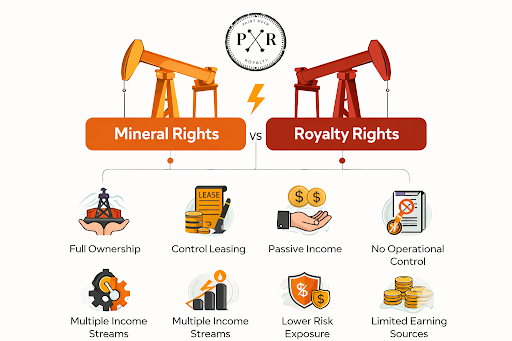
The difference between mineral rights and royalty rights lies in control, income potential, and responsibilities. Mineral rights provide full authority, while royalty rights offer limited passive income.
Comparison Table
Feature | Mineral Rights | Royalty Rights |
Ownership control | Full control over leasing and development | No control over operations |
Income sources | Lease bonus, royalties, and potential sale value | Only royalty payments |
Costs | May involve negotiation and management | No operational costs |
Decision making | The owner makes leasing decisions | No decision authority |
Flexibility | Can lease, sell, or transfer rights | Limited to receiving income |
This table simplifies the concept of mineral rights vs royalty interest, helping readers quickly understand the structural differences.
Working Interest vs Royalty Interest
Another related concept is working interest vs royalty interest, which often confuses new investors. A working interest owner participates directly in drilling and production activities, while a royalty interest owner receives income without operational involvement.
Key differences include:
- Working interest owners share both profits and costs
- Royalty interest owners receive income without expenses
- Working interest involves a higher risk and potential reward
- Royalty interest offers stable and predictable income
Understanding this distinction adds clarity when evaluating oil and gas investments.
Income Potential and Financial Considerations
Income is a major factor when comparing mineral rights vs royalty rights. Mineral rights owners can generate multiple income streams, while royalty owners rely solely on production revenue.
Mineral Rights Income Sources
- Lease bonus payments during contract signing
- Royalty payments based on production
- Potential profit from selling mineral rights
- Long-term appreciation in asset value
Royalty Rights Income Sources
- Regular royalty payments from production
- No additional income streams beyond royalties
In addition, royalty payments explained simply means a percentage of revenue from extracted minerals, typically defined in the lease agreement.
Lease Agreements and Ownership Structure
Oil and gas lease agreements play a critical role in defining both mineral and royalty ownership. These agreements determine the lease bonus and royalty percentage, which directly affect income.
Important elements include:
- Royalty percentage typically ranges from 12.5 percent to 25 percent
- The lease bonus is paid up front to mineral owners
- Lease duration defines production timelines
- Terms outline operator responsibilities
Furthermore, understanding oil and gas lease rights helps landowners negotiate better deals and maximize returns.
Net Mineral Acres vs Net Royalty Acres
Ownership is often measured using specific units, such as net mineral acres vs net royalty acres. These terms help quantify the extent of ownership in a property.
- Net mineral acres represent full ownership of subsurface minerals
- Net royalty acres reflect the share of production revenue
This distinction becomes important when evaluating property value or conducting a mineral rights appraisal.
Benefits and Limitations of Each Ownership Type
Both ownership types offer advantages and disadvantages depending on financial goals and risk tolerance.
Mineral Rights Benefits
- Greater control over leasing and development
- Multiple income streams
- Higher long-term value potential
Mineral Rights Limitations
- Requires active management and decision-making
- Market conditions can impact lease value
Royalty Rights Benefits
- Passive income without operational involvement
- No exposure to drilling costs
- Predictable revenue stream
Royalty Rights Limitations
- Limited control over operations
- Income depends entirely on production levels
Understanding royalty rights benefits and limitations helps investors align their strategy with financial goals.
Mineral Deed vs Royalty Deed
Legal documentation also differs between ownership types. A mineral deed vs. a royalty deed determines the nature of ownership transferred.
- Mineral deeds transfer full subsurface ownership rights
- Royalty deeds transfer only income rights
This distinction is essential when buying or selling assets.
Buyer Intent Considerations
Many landowners and investors face decisions such as whether to sell mineral rights vs royalty rights or whether to buy mineral rights or royalties.
When Selling Makes Sense
- Immediate cash needs
- Uncertain production outlook
- Desire to reduce management responsibilities
When Buying Makes Sense
- Long-term investment strategy
- Interest in passive income
- Confidence in production potential
In addition, using a royalty income calculation helps estimate potential earnings before making investment decisions.
Practical Example for Better Understanding
Consider a landowner who owns mineral rights and leases them to an oil company. The landowner receives a lease bonus and a royalty percentage from production.
On the other hand, a royalty owner who purchased royalty rights from that landowner only receives a portion of production income without any involvement in leasing decisions.
This example highlights the real-world difference between mineral ownership and royalty ownership.
Making the Right Decision
Choosing between mineral and royalty ownership depends on your financial goals, risk tolerance, and involvement preferences.
If you prefer control and multiple income streams, mineral rights may be more suitable. However, if you want passive income without operational responsibilities, royalty rights may be the better option.
For those considering transactions, it is important to compare mineral rights offers carefully and evaluate long-term value rather than focusing only on immediate payouts.
Conclusion
Understanding mineral rights vs royalty rights empowers landowners and investors to make informed decisions in the oil and gas industry. While mineral rights provide control and diverse income opportunities, royalty rights offer simplicity and passive income.
By analyzing ownership structure, income potential, and market conditions, you can choose the option that aligns with your financial goals and risk preferences.
Unlock the Full Value of Your Mineral Assets Today
Ready to take control of your oil and gas assets and make smarter decisions about your future income?
Explore expert guidance and tailored solutions at Paint Rock Royalty. Whether you want to sell, lease, or evaluate your mineral assets, their team provides transparent support every step of the way.
Take the next step today and turn your mineral potential into a real financial opportunity.
Frequently Asked Questions
What is the main difference between mineral rights and royalty rights?
Mineral rights provide full ownership and control, while royalty rights only provide income without operational authority.
Can I own both mineral and royalty rights?
Yes, a person can own both, depending on how the rights are acquired or transferred.
How are royalty payments calculated?
Royalty payments are based on a percentage of production revenue defined in the lease agreement.
Should I sell my mineral rights or keep them?
This depends on your financial needs, market conditions, and long-term investment goals.
Are royalty rights a good investment?
Royalty rights can provide stable passive income, but they depend on production performance and market conditions.