

Understanding how royalty income is calculated can feel complex for mineral owners. However, reservoir engineering brings clarity and confidence to this process. By combining science data and forecasting methods, reservoir engineering royalty estimates become more accurate and defensible.
This blog explains how reservoir engineering analysis directly influences royalty estimate calculation and why it matters for long-term value.
Understanding the Role of Reservoir Engineering in Royalties
Reservoir engineering focuses on evaluating subsurface formations to predict how oil and gas reservoirs will perform over time. These predictions are essential for oil and gas royalty forecasting because royalties depend on production volumes. When engineers analyze reservoir behavior they help estimate how much hydrocarbons can be economically recovered.
Reservoir engineering royalty estimates rely on pressure data, fluid properties and production history. As a result, mineral owners gain a clearer picture of potential income streams. Therefore better engineering leads to better financial decisions.
Why Accurate Royalty Estimates Matter for Mineral Owners
Royalty estimates influence decisions related to leasing, selling,g or holding mineral rights. An inaccurate estimate can undervalue assets or create unrealistic expectations. Because of this, professional reservoir engineering analysis plays a critical role.
Accurate royalty estimate calculation helps mineral owners plan finances with confidence. It also supports negotiations with operators and buyers. When production forecast modeling is grounded in engineering data, projections become more reliable.
Core Elements of Reservoir Engineering Analysis
Reservoir engineering analysis uses several technical components to evaluate future production. Each component adds precision to oil and gas royalty forecasting.
Key Inputs Used by Reservoir Engineers
Engineers evaluate a wide range of data sources, including geological and operational information.
- Reservoir pressure and temperature measurements
- Rock and fluid properties
- Historical production rates
- Well spacing and completion design
- Decline trends from nearby wells
These inputs allow engineers to build realistic production forecast modeling scenarios. Consequently, the royalty estimates reflect actual reservoir behavior rather than assumptions.
Production Forecast Modeling and Royalty Estimates
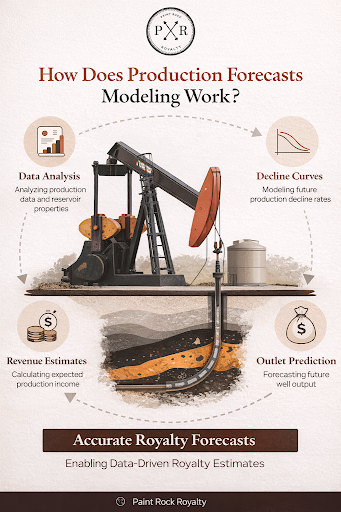
Production forecast modeling predicts how much oil or gas a well will produce over its life. This modeling directly affects reservoir engineering royalty estimates because royalties are paid as a percentage of production revenue.
Engineers use decline curve analysis and simulation tools to project production rates. As production declines over time, models help estimate future cash flow. Therefore, accurate modeling ensures royalty income is neither overstated nor underestimated.
Common Forecasting Techniques
Forecasting Method | Purpose | Impact on Royalty Estimates |
Decline curve analysis | Projects future production trends | Improves long-term royalty accuracy |
Volumetric analysis | Estimates the hydrocarbons in place | Supports early-stage estimates |
Reservoir simulation | Models fluid flow in the reservoir | Enhances detailed forecasting |
Each method contributes unique insights. When combined, they strengthen oil and gas royalty forecasting outcomes.
Estimated Ultimate Recovery Calculation Explained
The estimated ultimate recovery calculation measures the total volume of hydrocarbons expected to be produced from a reservoir. This value is fundamental to royalty estimate calculation.
Reservoir engineers calculate estimated ultimate recovery using production data and reservoir characteristics. As a result, mineral owners understand the full earning potential of their assets. Higher recovery values generally indicate stronger long-term royalty prospects.
How Estimated Ultimate Recovery Influences Royalties
Estimated ultimate recovery affects both the timing and magnitude of royalty payments. Larger recoveries mean extended production periods and sustained income. Therefore, this calculation plays a vital role in financial planning.
Royalty Estimate Calculation Step by Step
Royalty estimate calculation involves translating engineering forecasts into financial terms. This process requires careful consideration of pricing expenses and ownership interests.
Simplified Calculation Flow
- Estimate total recoverable production using reservoir engineering analysis
- Forecast production rates through production forecast modeling
- Apply commodity price assumptions
- Deduct applicable costs and taxes
- Multiply by the royalty interest percentage
Each step builds on engineering accuracy. Therefore, reservoir engineering royalty estimates remain central throughout the process.
The Link Between Reservoir Engineering and Asset Valuation
Mineral rights valuation depends heavily on expected royalty income. Because reservoir engineering defines production expectation,s it directly impacts valuation outcomes.
Buyers and sellers often rely on engineering-based estimates during transactions. When selling mineral rights through platforms like Paint Rock Royalty, accurate estimates protect the owner’s interests. As a result, engineering analysis supports fair market value.
Infographic Overview of the Royalty Estimation Process
Below is a simplified visual description to help readers grasp the workflow.
Infographic Description
- Geological data feeds into reservoir engineering analysis
- Analysis informs production forecast modeling
- Forecasts lead to the estimated ultimate recovery calculation
- Recovery estimates drive royalty estimate calculation
- Final output supports oil and gas royalty forecasting and valuation
This visual pathway shows how technical insights transform into financial clarity.
How Engineering Reduces Risk in Royalty Forecasting
Uncertainty is unavoidable in subsurface evaluation. However, reservoir engineering reduces risk by using data-driven methods. Sensitivity analysis and scenario modeling help account for variability.
By considering best-case and conservative scenarios, engineers provide balanced projections. Therefore, the mineral owners can make informed choices about leasing or selling through https://paintrockroyalty.com/lease-oil-and-gas-mineral-rights.
Real World Benefits for Mineral Owners
Reservoir engineering royalty estimates offer practical benefits beyond technical accuracy.
- Improved confidence during negotiations
- Better understanding of long-term income potential
- Stronger support when evaluating offers
- Reduced the likelihood of undervaluation
These advantages empower mineral owners to take control of their assets.
Choosing the Right Partner for Royalty Analysis
Not all estimates are created equal. Working with professionals who understand reservoir engineering analysis ensures reliable outcomes. Trusted platforms like https://paintrockroyalty.com provide guidance backed by expertise.
Experienced teams integrate engineering insights with market knowledge. As a result, royalty estimates align with real-world conditions.
Future Trends in Reservoir Engineering and Royalties
Technology continues to enhance reservoir evaluation methods. Advanced analytics and real-time data improve production forecast modeling accuracy. Consequently, oil and gas royalty forecasting becomes more precise.
As methods evolve, the mineral owners benefit from clearer projections and stronger decision support. Therefore,e staying informed about engineering advancements adds long-term value.
Take Control of Your Royalty Future with Confidence
Your mineral rights deserve clarity and confidence. When reservoir engineering royalty estimates guide your decisions, you protect long-term value. Explore trusted insights and professional support at https://paintrockroyalty.com. Whether you are leasing, selling, or simply learning, take the next step with knowledge on your side.
Start your journey today and unlock the true potential of your royalties.
Frequently Asked Questions
What are reservoir engineering royalty estimates?
They are projections of royalty income based on engineering analysis of reservoir performance and production forecasts.
How does production forecast modeling affect royalties?
It predicts future production volume, es which directly determines royalty payment amounts over time.
Why is the estimated ultimate recovery calculation important?
It defines the total production potential of a reservoir, which influences long-term royalty value.
Can the royalty estimate calculation change over time?
Yes, estimates evolve as new production data becomes available and reservoir behavior becomes clearer.
Should mineral owners rely on engineering-based estimates?
Yes, because reservoir engineering analysis provides data-driven insights that reduce uncertainty.