


Mineral owners often ask one important question before selling, leasing, or reviewing an offer. Does production history matter more, or does location carry more weight in valuation? The honest answer is that both matter, but they influence value in different ways. Strong production history shows current income and proven performance. However, location can reveal future drilling potential, operator interest, and long-range market demand.
Understanding mineral rights valuation factors helps owners avoid low offers and compare opportunities with confidence. Buyers do not look at one detail in isolation. Instead, they study production records, nearby well production data, lease activity in the area, operator activity near the property, and basin-level mineral value. Therefore, a fair estimate depends on both what the property has already produced and what the area may produce next.
For mineral owners in active regions, especially those researching mineral rights valuation in Texas, the difference can be significant. Two properties with similar royalty income may receive different offers because of location. Likewise, two properties in the same county can vary widely if one has a proven production history and another is non-producing.
Why Production History Matters in Mineral Rights Valuation
Production history mineral rights data gives buyers a record of what the property has already delivered. It shows whether the minerals are generating royalty checks, how stable those checks are, and whether revenue is rising or falling. Because of this, production history often becomes the first layer of oil and gas rights valuation.
A producing property usually has clearer cash flow than a non-producing property. Buyers can review monthly volumes, oil and gas production trends, pricing, royalty payments, and expenses. Then, they can build royalty income projections based on actual performance rather than pure speculation.
However, past production is not always equal to future value. Oil and gas wells naturally decline over time. This is why decline curve analysis is one of the most important mineral rights appraisal factors. A well that produced strongly two years ago may now be declining quickly. In contrast, a newer well may have lower historical totals but stronger future income potential.
Production history is especially useful because it helps answer these questions:
- How much royalty income has the owner received?
- Are production volumes steady, rising, or falling?
- Has the operator maintained consistent activity?
- Are current wells early in their life cycle or near maturity?
- Do revenue trends support the current mineral rights offer estimate?
As a result, oil production history valuation gives buyers confidence when income is already proven. Still, it does not tell the full story by itself.
Why Location Can Change the Value Completely
Mineral rights location value can be just as important as production history, especially in active basins. Location helps buyers understand what could happen next. A property may have modest current production, yet still attract strong offers because it sits near active drilling, strong operators, or valuable formations.
This is where mineral rights valued by location become powerful. Buyers study the county, basin, nearby leases, offset wells, permit activity, and drilling plans. They also compare county-level mineral rights pricing to recent sales and active buyer demand. Therefore, location can sometimes raise value even when current production is limited.
For example, non-producing mineral rights value may still be meaningful in a strong area. If nearby wells are performing well and operators are leasing aggressively, buyers may see future drilling potential. In that case, the location creates value before production begins.
Location matters because oil and gas development is not spread evenly. One tract may sit inside a high-demand drilling fairway, while another may be outside the most active zone. Even within the same county, small differences in geology, spacing, operator plans, and net mineral acres valuation can affect the fair market value of mineral rights.
Production History vs Location Comparison Table
Valuation Factor | What It Shows | Why Buyers Care | Main Risk |
Production history | Past and current royalty income | It supports cash flow estimates | Wells may decline faster than expected |
Location | Future development potential | It shows basin, county, and operator demand | Activity may not reach the property |
Nearby well production data | Performance around the tract | It helps estimate possible future output | Nearby results may not repeat exactly |
Operator activity near the property | Leasing, drilling, and permits | It signals an active development interest | Plans can change with market conditions |
Net mineral acres valuation | Ownership size and depth of rights | It affects the total possible revenue | Title details may reduce ownership value |
This table shows why the best valuation process uses both production history and location. One factor explains proven income, while the other explains future opportunity.
Which Matters More for Producing Minerals?
For producing minerals, production history often carries more immediate weight. Current income can be measured, verified, and projected. Buyers can review actual royalty statements and match them with public production records. Therefore, producing assets usually receive offers based on current cash flow and future decline expectations.
However, location still matters because not all producing minerals have the same future. If a producing tract sits near new drilling permits, active operators, and strong offset wells, buyers may pay more. In contrast, a producing tract in a slower area may receive a lower multiple, even with similar current income.
This is why owners should never judge value only by recent royalty checks. A strong check history may look attractive, but a careful buyer will still ask where the property sits. Similarly, a weaker income stream may still support a better valuation if the location points to future wells.
Which Matters More for Non-Producing Minerals?
For non-producing minerals, location usually matters more. Without current royalty income, buyers must focus on future drilling potential. They look at basin trends, lease activity, nearby wells, active operators, and county-level pricing. Because of this, mineral rights location value becomes the main driver.
A non-producing property in a quiet area may have limited buyer interest. Yet a non-producing property in a strong drilling area can attract competitive offers. In some cases, buyers may value the minerals based on expected development rather than current revenue.
This is especially important for owners who want to sell mineral rights for fair value. Accepting the first offer without understanding the location can leave money on the table. A better approach is to get mineral rights appraisal support that compares both ownership details and market activity.
How Buyers Value Mineral Rights in Real Situations
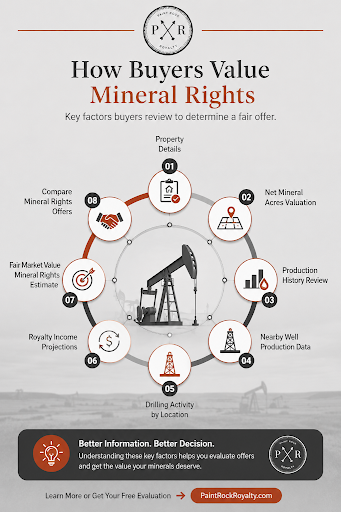
Most buyers use a blended approach. They do not simply ask whether production history or location matters more. Instead, they weigh both based on risk and opportunity. A strong buyer evaluation may include title review, production analysis, offset activity, lease status, and market comparison.
Here are the common mineral rights appraisal factors buyers review:
- Net mineral acres owned
- Royalty rate and lease terms
- Producing and non-producing acreage
- Operator quality and nearby activity
- Monthly royalty income history
- Decline curve analysis
- Basin level mineral value
- County-level mineral rights pricing
- Future drilling potential
- Comparable offers and recent transactions
Consequently, oil and gas rights valuation works best when it combines data with market judgment. Numbers matter, but context matters too.
Common Mistakes Mineral Owners Make
Many owners focus only on royalty income. That can be risky because income is only one part of value. Others focus only on location and ignore the decline profile of current wells. That can also create unrealistic expectations.
Another common mistake is comparing offers without understanding how buyers calculate them. One offer may appear higher, but it may include different assumptions about acreage, title, deductions, or future drilling. Therefore, owners should compare mineral rights offers carefully before making a decision.
Owners should also avoid assuming that county averages apply to every property. County-level mineral rights pricing is useful, but it is not exact. A tract near strong wells can be worth more than the county average. Meanwhile, a tract outside active development may be worth less.
So, Which Matters More?
Production history matters more when current income is strong, stable, and supported by long-term well performance. Location matters more when future drilling potential is the main source of value. In many cases, the highest valuations happen when both are strong.
A property with proven production history in an active location is often more attractive to buyers. It provides current income and future upside. On the other hand, a property with declining production in a slow area may receive a lower valuation. Likewise, non-producing minerals in a high activity area may still command interest because buyers see future development possibilities.
Ultimately, the factors in mineral rights valuation work together. The right question is not only production history vs location. The better question is how production history and location combine to create fair market value mineral rights.
Why Work With Paint Rock Royalty
Paint Rock Royalty helps mineral owners understand value before they make important decisions. Whether you are reviewing an offer, planning to sell, or considering lease options, a clear valuation process can protect your interests.
If you want to compare mineral rights offers, understand a mineral rights buyer evaluation, or get mineral rights appraisal guidance, expert review can help. Instead of guessing, you can evaluate your property through production data, location trends, operator activity, and market demand.
Get a Fair Mineral Rights Valuation Today
Your mineral rights may be worth more than a simple offer letter suggests. Whether you receive royalty checks, own non-producing minerals, or already have an offer in hand, Paint Rock Royalty can help you understand the real value of your property.
Request a clear mineral rights appraisal today and compare your options with confidence before you sell, lease, or accept an offer.
Frequently Asked Questions
What are the most important mineral rights valuation factors?
The most important mineral rights valuation factors include production history, location, net mineral acres, royalty rate, lease terms, nearby well production data, operator activity, and future drilling potential. A complete valuation should review both current income and future opportunity.
Does production history mineral rights data always increase value?
Production history can increase value when it shows steady income and strong well performance. However, declining wells may reduce value if future royalty income is expected to fall. Buyers often use decline curve analysis to estimate remaining cash flow.
Why does mineral rights location value vary so much?
Mineral rights location value varies because drilling activity, geology, operator interest, and basin performance differ by area. Even properties in the same county can have different values based on nearby wells, lease activity, and future development plans.
How do buyers value mineral rights before making an offer?
Buyers review production income, location, title details, net mineral acres, royalty rate, operator activity, nearby well results, and comparable market data. Then, they create a mineral rights offer estimate based on expected income, risk, and buyer demand.
Should I get mineral rights appraisal help before selling?
Yes, appraisal help can be valuable before selling. A professional review can help you understand fair market value mineral rights, compare offers, and avoid accepting a price that does not reflect production history or location potential.