

Royalty owners often feel concerned when monthly payments begin shrinking without a clear explanation. Many people ask, “Why is my royalty check going down?” after noticing sudden income reductions from oil and gas production. Understanding the reasons behind declining royalty payments can help mineral owners make informed financial decisions.
Royalty income depends on several factors that influence oil and gas production, market pricing, and operational costs. In many cases, lower oil and gas royalty checks result from natural production decline rather than administrative errors. However, deductions, pricing changes, and operator decisions may also reduce payments over time.
Understanding these changes allows royalty owners to protect their financial interests while evaluating long-term mineral asset value.
Understanding How Royalty Payments Work
Royalty payments come from oil and gas production generated from mineral rights ownership. Operators produce hydrocarbons from wells and distribute royalties based on ownership percentages and production revenue.
Several elements affect monthly payments:
- Commodity prices
- Well production volumes
- Royalty decimal interest
- Post-production deductions
- Operational expenses
- Market demand
When one or more of these factors change, a decrease in royalty income becomes noticeable on monthly statements.
Common Reasons Royalty Checks Decrease
Many royalty owners become alarmed when payments suddenly decline. However, several predictable industry factors contribute to the reduced royalty payments oil and gas owners experience regularly.
Major Causes of Declining Royalty Payments
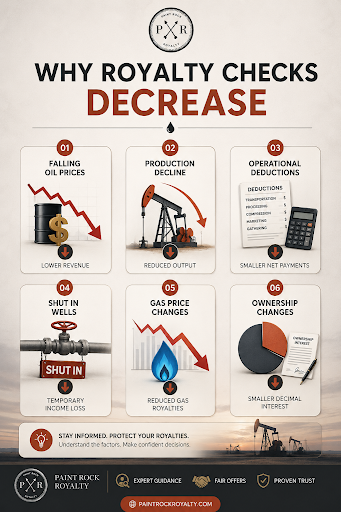
Factor | Impact on Royalty Income |
Oil production decline rates | Lower monthly production |
Commodity price fluctuations | Reduced revenue value |
Post-production deductions | Increased expenses |
Natural gas price changes | Smaller gas royalties |
Well production slowdown | Lower output volumes |
Shut in wells | Temporary payment suspension |
Understanding these factors helps explain why royalty checks often decrease over time.
Oil Production Decline Rates
Every oil and gas well experiences production decline after reaching peak output. This natural depletion process significantly affects royalty payments.
How Production Decline Works
New wells typically produce large volumes during the early months. However, production gradually decreases as reservoir pressure declines. As a result, royalty checks become smaller even when commodity prices remain stable.
Typical Production Stages
Well Stage | Production Level |
Initial Production | Highest output |
Mid Life Production | Moderate decline |
Mature Production | Stable lower output |
Late Life Production | Minimal production |
Depletion of oil wells remains one of the most common reasons royalty checks decrease.
Commodity Price Fluctuations
Oil and gas markets constantly fluctuate due to global economic conditions, supply levels, and geopolitical events. Even productive wells can generate lower royalties during weak commodity markets.
How Oil Prices Affect Royalty Income
Royalty owners receive payments based on production revenue rather than fixed rates. Therefore, falling oil or natural gas prices directly reduce royalty income.
For example:
- Higher oil prices increase royalty revenue
- Lower gas prices reduce monthly checks
- Market instability affects payment consistency
Commodity price fluctuations often create noticeable swings in monthly royalty income.
Natural Gas Price Changes
Natural gas prices can experience significant volatility depending on weather conditions, export demand, and storage levels.
Factors Affecting Gas Prices
- Seasonal energy demand
- Pipeline capacity
- International exports
- Economic growth
- Weather conditions
Natural gas price changes frequently affect royalty owners with gas-producing wells more dramatically than oil-focused properties.
In some cases, companies may suspend royalty payments until production resumes.
Understanding Post Production Deductions
Many royalty owners become confused after reviewing deductions on royalty statements. Post-production deductions reduce payments by subtracting operational costs after production occurs.
Common Royalty Statement Deductions
Deduction Type | Purpose |
Transportation | Pipeline delivery costs |
Compression | Gas pressure management |
Processing | Gas treatment expenses |
Marketing | Product sales expenses |
Gathering | Moving product from wells |
Understanding deductions on royalty checks helps owners verify payment accuracy and identify unexpected expenses.
Royalty Decimal Interest Changes
Royalty decimal interest determines the ownership percentage used to calculate payments. Changes to ownership records can affect royalty income.
Reasons Decimal Interests Change
- Property sales
- Inheritance transfers
- Lease amendments
- Title corrections
- Division order updates
Even small decimal interest changes can reduce monthly royalty payments significantly.
Well Production Slowdown
Wells sometimes experience operational problems that reduce production efficiency. Mechanical issues or maintenance needs can slow output temporarily.
Common Operational Problems
- Equipment failures
- Water production increases
- Pipeline disruptions
- Pressure declines
- Maintenance shutdowns
Operator production reports often explain temporary production slowdowns affecting royalty income.
Shut In Wells and Royalties
Operators occasionally shut in wells temporarily because of maintenance, market conditions, or pipeline limitations. During shut-in periods, royalty checks may decrease substantially or stop completely.
Reasons Wells Are Shut In
Shut In Cause | Impact on Royalties |
Pipeline maintenance | Temporary payment reduction |
Equipment repairs | Short-term shutdown |
Weak commodity prices | Production suspension |
Regulatory requirements | Delayed operations |
Shut-in wells and royalties often create confusion among mineral owners unfamiliar with industry operations.
Mineral Rights Royalty Decline Over Time
Most mineral properties experience declining production naturally. Although new wells can increase revenue temporarily, older wells eventually produce smaller volumes.
Long-Term Royalty Trends
- Early years produce the highest payments
- Midlife wells stabilize gradually
- Mature wells decline consistently
- Older wells generate smaller checks
Mineral rights royalty decline remains a normal part of oil and gas production economics.
Reviewing Operator Production Reports
Operator production reports provide valuable insights into well performance and payment changes. These reports often explain production declines and operational interruptions.
Information Included in Production Reports
- Oil and gas market prices
- Equipment repair costs
- Reservoir pressure levels
- Transportation access
- Future profitability expectations
If conditions improve, operators may reactivate production and restore royalty payments.
How to Evaluate Royalty Payments
Royalty owners should monitor statements carefully to identify errors or unusual deductions.
Important Evaluation Steps
- Compare monthly production volumes
- Review commodity price changes
- Check deduction categories
- Verify decimal interests
- Request operator reports
Evaluate royalty payments regularly to ensure accuracy and identify potential issues early
When to Consider a Mineral Rights Valuation
Some owners explore mineral rights valuation when royalty income declines significantly. Understanding property value helps owners evaluate long-term financial options.
Factors Affecting Mineral Value
Valuation Factor | Influence |
Current production | Revenue potential |
Commodity prices | Market value |
Remaining reserves | Long-term income |
Operator activity | Future development |
Nearby drilling | Growth opportunities |
Professional valuation helps owners make informed decisions regarding ownership strategies.
Should You Sell Mineral Rights for Cash?
Some royalty owners choose to sell mineral rights for cash after production declines significantly. Selling provides immediate liquidity rather than uncertain future income.
Reasons Owners Sell Mineral Rights
- Declining royalty income
- Estate planning needs
- Financial flexibility
- Market timing opportunities
- Diversification goals
Companies like Paint Rock Royalty help owners evaluate mineral rights and explore selling opportunities.
Explore mineral rights solutions here:
Importance of Oil and Gas Royalty Analysis
Professional oil and gas royalty analysis helps identify inaccuracies, missing payments, or excessive deductions.
Benefits of Royalty Analysis
- Verifies payment accuracy
- Identifies underpayments
- Reviews operator deductions
- Confirms ownership interests
- Supports financial planning
Royalty owners with complex properties often benefit from detailed analysis services.
Royalty Audit Services Texas
Texas remains one of the largest oil and gas-producing states in America. Many mineral owners use royalty audit services that Texas professionals provide to evaluate payment records.
Audit Services Typically Include
- Payment verification
- Lease compliance reviews
- Deduction analysis
- Ownership verification
- Production comparisons
Audits help ensure operators distribute payments correctly according to lease agreements.
Protecting Your Long-Term Royalty Income
Royalty owners should remain proactive when monitoring mineral assets. Understanding industry trends and operational changes helps protect future income.
Best Practices for Royalty Owners
- Keep detailed payment records
- Monitor production activity
- Review lease agreements carefully
- Evaluate market conditions
- Seek professional guidance when needed
Educated royalty owners make stronger financial decisions regarding mineral assets.
Understanding the Future of Royalty Payments
Royalty payments naturally fluctuate throughout the life of oil and gas properties. Production decline, pricing changes, and operational decisions all influence monthly income.
Although declining royalty payments may feel concerning, many reductions result from predictable industry conditions. Understanding the reasons royalty checks decrease helps owners manage expectations while evaluating future opportunities.
Whether you plan to maintain ownership, lease mineral rights, or sell mineral rights for cash, informed decision-making remains essential. Paint Rock Royalty continues helping mineral owners understand their assets while exploring practical financial solutions.
Explore Your Mineral Rights Opportunities
Protect your financial future by understanding royalty income trends and evaluating your mineral assets carefully.
Paint Rock Royalty helps mineral owners analyze royalties, evaluate mineral rights value, and explore flexible ownership solutions.
Visit: https://paintrockroyalty.com/
Sell Mineral Rights: https://paintrockroyalty.com/selling-mineral-rights
Lease Mineral Rights: https://paintrockroyalty.com/lease-oil-and-gas-mineral-rights
Frequently Asked Questions
Why is my royalty check going down every month?
Royalty checks often decrease because of declining well production, lower oil prices, operational deductions, or reduced natural gas prices.
Can oil prices affect royalty payments?
Yes. Commodity price fluctuations directly influence royalty revenue because payments depend on oil and gas market values.
What are post-production deductions?
Post-production deductions include transportation, processing, gathering, and marketing costs subtracted from royalty payments.
What happens when wells are shut in?
Shut-in wells temporarily stop production, which reduces or suspends royalty payments until operations resume.
Should I sell mineral rights if royalties decline?
Selling mineral rights depends on financial goals, market conditions, and future production expectations. Professional valuation can help owners decide.