

Oil and gas royalties provide an important source of income for many mineral owners across the United States. However, uncertainty often arises when production stops or a well becomes inactive. Many owners wonder about royalties when a well shuts down and how their future payments may change.
Understanding royalty rights after production stops is essential for protecting your financial interests. A temporary production pause does not always mean royalty income disappears permanently. Several legal and operational factors determine what happens next.
Oil companies may suspend operations for maintenance, economic conditions, or reservoir management. In some situations, wells can restart production after a temporary shutdown. Therefore, mineral owners should understand how oil well shutdown royalty payments work and what rights remain active during inactivity periods.
Understanding Oil and Gas Royalties
Mineral royalties are payments made to mineral rights owners for the extraction of oil and gas resources from their property. These payments represent a percentage of production revenue without requiring owners to cover drilling expenses.
Royalty income depends on several factors:
- Production volume
- Market prices
- Lease agreements
- Ownership percentage
- Operating conditions
When production remains active, royalty checks continue according to lease terms. However, suspended royalty payments in oil and gas situations can occur if production stops temporarily or permanently.
Why Oil Wells Shut Down
Oil wells may stop producing for several reasons. Some shutdowns last only a few weeks, while others continue for years.
Common Causes of Well Shutdowns
Reason | Impact on Production |
Low oil prices | Reduces economic viability |
Equipment maintenance | Temporary production suspension |
Pipeline issues | Delays transportation |
Reservoir depletion | Declining production output |
Regulatory requirements | Operational restrictions |
Market instability | Delayed operations |
Understanding the reason behind a shutdown helps mineral owners evaluate the future potential of royalty income.
What Happens to Royalties When a Well Shuts Down
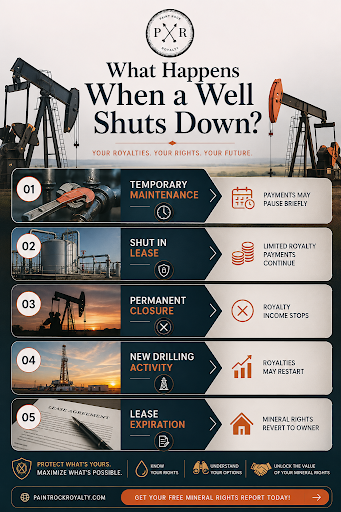
The future of royalty payments depends on whether the shutdown is temporary or permanent. Mineral owners often assume royalty income ends immediately after production stops. However, lease agreements may contain clauses that allow companies to maintain operational rights during inactivity periods.
Temporary Shutdowns
Temporary shutdowns usually occur because of maintenance, market conditions, or transportation problems. In these cases, production may restart later.
If the operator expects future production, the lease may remain active through well shut-in royalty clauses.
Permanent Shutdowns
Permanent closures happen when production becomes economically unfeasible or the reservoir becomes depleted. Once a well permanently ceases operations, royalty payments generally stop unless new drilling activities begin later.
Understanding Well Shut-In Royalty Clauses
Many oil and gas leases contain shut-in clauses that protect operators during temporary inactivity periods. These clauses allow companies to maintain lease rights even if production stops temporarily.
Instead of regular royalty checks, mineral owners may receive smaller shut-in royalty payments to keep the lease active.
Purpose of Shut-In Clauses
Clause Benefit | Explanation |
Protects the lease validity | Prevents lease termination |
Allows future production | Supports operational flexibility |
Maintains mineral rights agreements | Keeps contracts enforceable |
Provides limited compensation | Owners receive shut-in payments |
Well, shut-in royalty clauses are especially common in natural gas operations where market conditions fluctuate frequently.
Oil Well Shutdown Royalty Payments Explained
Royalty payments during shutdown periods vary according to lease terms and operational status.
Possible Payment Scenarios
Continued Shut-In Payments
Some leases require operators to pay annual shut-in royalties while the well remains inactive.
Suspended Payments
In some cases, companies may suspend royalty payments until production resumes.
Lease Expiration
If the lease lacks valid shut-in provisions, mineral rights may revert to the owner after inactivity.
Understanding lease language is essential when evaluating inactive oil well royalty rights.
Inactive Oil Well Royalty Rights
Mineral owners retain important legal rights even after a well becomes inactive. These rights depend heavily on lease agreements and state regulations
Rights Mineral Owners May Retain
- Ownership of mineral interests
- Future royalty eligibility
- Lease renegotiation opportunities
- Ability to sell mineral rights
- Legal review of lease compliance
Inactive wells do not automatically eliminate ownership rights. Therefore, mineral owners should monitor lease activity carefully.
What Happens to Mineral Royalties After Production Stops
Production stoppages create uncertainty for many royalty owners. However, several possible outcomes may occur after the operations pause.
Common Outcomes After Production Stops
Outcome | Description |
Production resumes | Royalties restart |
Well remains shut in | Limited payments continue |
Lease expires | The rights return to the owner |
New operator acquires lease | Operations may restart |
Property redeveloped | New drilling opportunities emerge |
The future potential of the property often influences operational decisions.
Factors That Affect Royalty Payments During Shutdowns
Several operational and legal factors determine whether royalty income continues during inactive periods.
Important Factors Include
- Lease agreement language
- Duration of inactivity
- Market oil prices
- Reservoir performance
- Operator financial stability
- State mineral regulations
Because every lease differs, a professional review can help owners understand their options clearly.
Importance of Reviewing Oil and Gas Leases
Oil and gas leases contain detailed legal terms that directly impact royalty rights. Many mineral owners overlook critical clauses that affect payments during shutdowns.
Key Lease Clauses to Review
Lease Clause | Importance |
Shut-in royalty clause | Maintains lease validity |
Production requirements | Defines active operations |
Payment obligations | Explains royalty structure |
Lease termination terms | Determines expiration rights |
Surface use provisions | Governs operational access |
Reviewing lease agreements regularly helps owners protect their long term financial interests.
Can Mineral Owners Sell Rights During Well Shutdowns?
Yes, mineral owners can still sell their rights even if production stops temporarily. In fact, many investors purchase mineral rights based on future drilling potential rather than current production.
Property location, geological potential, and nearby drilling activity influence market value significantly.
Reasons Owners Sell Mineral Rights
- Immediate financial needs
- Estate planning
- Market uncertainty
- Declining production
- Diversification strategies
Paint Rock Royalty helps mineral owners understand the value of their assets and evaluate selling opportunities professionally.
Learn more here:
How Operators Decide to Restart Production
Oil companies carefully evaluate several economic and operational conditions before restarting inactive wells.
Key Restart Considerations
- Oil and gas market prices
- Equipment repair costs
- Reservoir pressure levels
- Transportation access
- Future profitability expectations
If conditions improve, operators may reactivate production and restore royalty payments.
Protecting Your Mineral Rights
Mineral owners should stay informed about operational activity affecting their property. Monitoring lease compliance and production reports can help prevent misunderstandings.
Practical Steps for Mineral Owners
- Review lease agreements carefully
- Maintain organized payment records
- Monitor operator communication
- Consult mineral rights professionals
- Understand state regulations
Proactive management helps owners protect future royalty income opportunities.
The Role of Professional Guidance
Oil and gas royalties involve complex legal and financial considerations. Professional guidance can help owners make informed decisions regarding lease negotiations, royalty disputes, and asset sales.
Experienced mineral rights companies provide valuable insights into market trends and royalty valuation.
Paint Rock Royalty works with mineral owners to simplify the process while offering transparent guidance regarding mineral assets and royalty interests.
Understanding Long-Term Mineral Value
Temporary well shutdowns do not always eliminate long-term mineral value. Many properties retain future development potential even after production pauses.
Energy companies continuously evaluate emerging drilling technologies and market opportunities. Therefore, inactive wells may eventually return to production under improved conditions.
Mineral owners who understand their rights and lease terms remain better positioned to make informed financial decisions.
Secure Your Future with Professional Mineral Rights Support
Understanding royalties when a well shuts down helps mineral owners protect their financial interests and evaluate future opportunities confidently.
Whether production pauses temporarily or operations stop permanently, knowing your inactive oil well royalty rights remains essential for long-term asset management.
Paint Rock Royalty provides experienced support for mineral owners seeking guidance on royalty payments, lease agreements, and mineral rights opportunities.
Explore Your Mineral Rights Opportunities Today
Protect your royalties and understand your options with expert guidance from Paint Rock Royalty. Whether you need help reviewing leases, selling mineral rights, or understanding royalty payments, professional support can help you make informed decisions.
Discover trusted mineral rights solutions and personalized guidance designed to protect your long-term financial interests.
Visit: https://paintrockroyalty.com/
Learn About Selling Rights: https://paintrockroyalty.com/selling-mineral-rights
Explore Leasing Information: https://paintrockroyalty.com/lease-oil-and-gas-mineral-rights
Frequently Asked Questions
Do royalty payments stop immediately when a well shuts down?
Royalty payments may pause temporarily, continue through shut-in clauses, or stop permanently, depending on lease terms and operations.
What are shut-in royalty clauses?
Shut-in clauses allow operators to maintain lease rights during temporary inactivity by making limited royalty payments.
Can an inactive oil well start producing again?
Yes, wells may restart production if market conditions and operational factors improve in the future.
Can mineral rights still be sold after production stops?
Yes, mineral rights can often be sold based on future development potential and geological value.
Why should mineral owners review lease agreements?
Lease agreements determine royalty rights, payment obligations, shut-in provisions, and operational responsibilities.