


Understanding mineral rights valuation factors is essential before accepting any offer for your oil and gas interests. Many mineral owners receive a mineral rights cash offer and wonder why the number differs from another buyer’s estimate. The reason is simple. Mineral rights are valued through several technical, legal, market, and location-based considerations.
A fair offer is not based on one number alone. Instead, buyers review your acreage, production, lease terms, operator activity, title records, commodity prices, and future drilling potential. Therefore, two buyers may calculate different values for the same mineral ownership.
Paint Rock Royalty helps mineral owners understand how mineral rights are valued before making an important decision. Whether you want to sell mineral rights for fair value, compare mineral rights offers, or request a mineral rights offer estimate, knowing these factors gives you more control.
What Are Mineral Rights Valuation Factors?
Mineral rights valuation factors are the details buyers review when estimating the value of oil and gas ownership. These details help determine the likely income your minerals may produce now and in the future.
Common mineral rights appraisal factors include:
- Net mineral acres
• Royalty interest percentage
• Production history
• Lease terms and royalty rate
• Active drilling activity
• Nearby well performance
• Basin location value
• Oil and gas price trends
• Operator activity
• Title verification process
• Future drilling potential
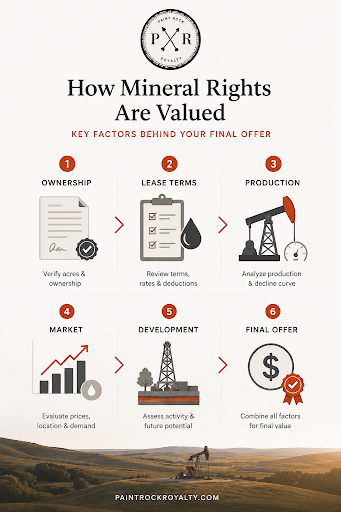
Together, these factors shape your mineral rights final offer. As a result, a strong property in an active basin may receive a higher offer than minerals with limited production and uncertain title records.
How Mineral Rights Are Valued
Many owners ask how mineral rights are valued because offers can feel confusing. Buyers usually begin by estimating expected future cash flow. Then, they adjust that estimate based on risk, title clarity, market conditions, lease quality, and development potential.
In simple terms, a mineral rights offer calculation often includes three major questions.
- How much income are the minerals producing today?
• How much income could they produce in the future?
• How much risk exists before that income is received?
Therefore, mineral valuation is both a financial review and a risk review. A buyer is not only paying for current royalty checks. The buyer is also pricing future possibilities and future uncertainty.
Key Factors That Affect Mineral Rights Value
The table below explains the major factors that affect mineral rights value and why each one matters.
Valuation Factor | Why It Matters | Possible Impact On Offer |
Net mineral acres | Shows how much ownership you actually control | More acres can increase value |
Production history | Reveals past and current royalty income | Strong production may support higher offers |
Royalty interest percentage | Determines your share of production revenue | Higher royalty interest can increase value |
Lease terms and royalty rate | Affects income structure and deductions | Better lease terms may improve valuation |
Nearby well performance | Shows how similar wells are performing nearby | Strong wells can improve buyer confidence |
Active drilling activity | Indicates current development interest | More activity may raise future value |
Basin location value | Certain basins attract stronger buyer demand | Prime locations often receive better offers |
Oil and gas price trends | Market prices affect projected revenue | Higher prices may increase offers |
Title verification process | Confirms legal ownership and transferability | Title issues can reduce or delay offers |
Future drilling potential | Shows possible upside from new wells | Strong upside may increase the final value |
Net Mineral Acres And Ownership Size
Net mineral acres are one of the most important inputs in oil and gas mineral valuation. They show the actual mineral ownership you hold after accounting for your fractional interest.
For example, owning a portion of minerals under a larger tract is different from owning the entire mineral interest. Buyers need to calculate their true ownership before creating a mineral rights buyer offer.
This is why mineral deed ownership matters. A deed may describe the tract, but the actual ownership percentage can require deeper review. Consequently, accurate records can help support a stronger and cleaner offer process.
Production History And Royalty Income
Production history shows how your minerals have performed over time. Buyers review royalty statements, well records, production volumes, and payment trends. This helps them estimate future revenue.
The question of how production history affects mineral rights value is important because producing minerals often carries more proven value. If the wells are generating steady income, buyers can use that income to support their offer.
However, production usually declines over time. Therefore, buyers often use decline curve analysis to estimate how quickly well output may decrease. High current income is helpful, but long-term production expectations matter just as much.
Producing Vs Non Producing Minerals
The difference between producing and non-producing minerals can significantly change your offer. Producing minerals already generates royalty income, which gives buyers more data for valuation. Non-producing minerals may still be valuable, especially in active areas. However, they carry more uncertainty because future income depends on drilling decisions, operator plans, and market conditions.
As a result, non-producing minerals in a strong basin may still attract serious interest. Meanwhile, producing minerals in a declining area may receive a more conservative valuation.
Royalty Interest Percentage And Lease Terms
Your royalty interest percentage directly affects your share of production revenue. A higher royalty rate usually means more income from each barrel of oil or unit of gas sold.
Buyers also review lease terms and royalty rate because lease language can affect long-term value. Some leases include provisions that protect mineral owners better than others.
Important lease details may include:
- Royalty rate
• Lease term length
• Deduction language
• Shut-in provisions
• Pooling language
• Bonus terms
• Extension clauses
Additionally, post-production deductions can reduce the amount received from royalty payments. These deductions may include costs related to gathering, transportation, processing, or marketing. Because of this, buyers study the lease before finalizing an offer.
Location And Basin Value
The question of how location affects mineral rights valuation is central to almost every appraisal. Minerals located in active oil and gas basins usually attract stronger buyer demand.
Basin location value depends on geology, infrastructure, operator interest, nearby results, and drilling economics. A property in an active development area may receive a stronger offer than one in a less proven region.
Paint Rock Royalty lists areas of interest on its website, which suggests that location plays an important role in its review process. For mineral owners, this means the county, basin, formation, and nearby operator activity can all influence market value.
Nearby Well Performance And Operator Activity
Buyers often study nearby well performance to understand what your minerals could produce. If surrounding wells are strong, your acreage may look more attractive.
In addition, operator activity can influence buyer confidence. If reputable operators are drilling nearby, filing permits, completing wells, or expanding development, minerals in that area may gain value.
However, nearby success does not guarantee future results. Mineral buyers still consider spacing, geology, title, lease terms, and your exact ownership location. Therefore, strong nearby wells can help, but they are not the only factor.
Oil And Gas Price Trends
Oil and gas price trends affect the expected revenue from mineral interests. When prices rise, future royalty income may look more attractive. When prices fall, buyers may become more cautious.
This is one reason why mineral rights offers vary between buyers. Different buyers may use different price assumptions, risk models, and investment goals. Some may focus on current production, while others may value long-term development potential more aggressively.
Consequently, an offer should be reviewed in context. A number that looks low during a strong market may deserve closer review. A number that looks high may also include assumptions that need explanation.
Title Verification Process
The title verification process confirms who owns the minerals and whether those rights can be sold. This step is critical because unclear ownership can delay or reduce a final offer.
Buyers may review deeds, probate documents, leases, assignments, division orders, and county records. If the title is clean, the process may move faster. If records are incomplete, the buyer may adjust the offer or request additional documentation.
Because mineral ownership can pass through families, estates, and multiple transactions, title issues are common. Therefore, clear documentation can help protect your value during negotiations.
Why Your Mineral Rights Final Offer Can Change
A mineral rights final offer may change after deeper review. Initial estimates are often based on available information. Final offers are usually based on verified ownership, lease terms, title records, production data, and market assumptions.
Common reasons a final offer changes include:
- The net mineral acres are different from expected
• The royalty interest percentage is lower than estimated
• Production has declined faster than projected
• Title records show ownership issues
• Lease terms include unfavorable deductions
• Nearby drilling activity has changed
• Oil and gas prices moved significantly
• Buyer risk assumptions changed after review
This explains what changes your mineral rights final offer. It also shows why mineral owners should understand the valuation process before signing a purchase agreement.
How Buyers Calculate Mineral Rights Offers
The question of how buyers calculate mineral rights offers usually comes down to income, risk, and upside. Buyers may estimate future royalties from current wells, then discount those expected payments to account for time and uncertainty.
For undeveloped minerals, buyers may study nearby wells, drilling permits, spacing units, and operator plans. They may also consider whether the area is likely to see future development.
A reliable mineral rights offer estimate should be based on more than a quick guess. It should reflect ownership data, market knowledge, and careful evaluation. Therefore, mineral owners should compare mineral rights offers before making a final decision.
Getting A Fair Mineral Rights Market Value
Your mineral rights market value depends on what informed buyers are willing to pay for your specific interest. Since each buyer may view risk differently, it is wise to understand the basis behind every offer.
To sell mineral rights for fair value, consider these steps:
- Gather royalty statements and lease documents
• Confirm your mineral deed ownership records
• Ask how the buyer calculated the offer
• Compare mineral rights offers from trusted mineral rights buyers
• Review whether the offer accounts for future drilling potential
• Understand any title conditions before closing
For owners seeking mineral rights appraisal, Texas support,t or a broader oil and gas mineral valuation, professional guidance can be valuable. Texas mineral ownership can be especially complex because of active basins, long ownership histories, and competitive buyer interest.
Why Work With A Trusted Mineral Rights Buyer?
A trusted buyer should explain the process, review your property carefully, and provide a clear path from valuation to closing. Paint Rock Royalty presents services related to selling mineral rights, leasing oil and gas mineral rights, and helping owners understand the process.
If you want to get a mineral rights valuation, the best starting point is a conversation with a buyer who understands the market. A transparent buyer can help you understand your options and avoid accepting an offer without proper context.
Most importantly, you should feel comfortable asking questions. A serious buyer should be able to explain the major valuation drivers behind the offer.
Make A Confident Mineral Rights Decision
Mineral rights valuation is not random. It is shaped by ownership, production, lease terms, location, market conditions, operator activity, and title quality. When you understand these factors, you can better evaluate a mineral rights cash offer and make a more confident decision.
Before accepting any offer, take time to understand how mineral rights are valued. Compare your options, ask questions, and work with trusted mineral rights buyers who explain their process clearly.
Find Out What Your Minerals Are Worth
Your minerals may be worth more than a quick estimate suggests. Start with a clear valuation, understand your strongest value drivers, and see what a fair offer could look like today.
Visit Paint Rock Royalty to request a mineral rights valuation, compare your options, and take the next step with confidence.
Frequently Asked Questions
What are the most important mineral rights valuation factors?
The most important factors include net mineral acres, production history, royalty interest percentage, lease terms, location, title status, nearby well performance, and future drilling potential.
How do net mineral acres impact mineral rights offers?
Net mineral acres show your actual ownership size. More net mineral acres usually support a higher offer, especially in active oil and gas areas.
Why do mineral rights offers vary between buyers?
Offers vary because buyers use different assumptions for prices, decline rates, drilling potential, lease quality, title risk, and expected future income.
Can non-producing minerals still have value?
Yes. Non-producing minerals can be valuable when they are located near active drilling, strong operators, productive wells, or attractive basin locations.
How can I compare mineral rights offers fairly?
Compare the offer amount, closing terms, title requirements, buyer reputation, valuation explanation, and whether future drilling potential was considered.